trans_fn is the general-purpose escape hatch for a non-rigid
deformation not covered by trans_warp()'s noise-driven domain
warping: it wraps a caller-supplied displacement function directly,
the same relationship trans_affine() has to the rigid trans_*()
family.
Details
fn is called as fn(x, y), where x/y are a drawable's own
computed points (already flattened to plain numeric vectors, not an
xy object), and must return a list(x = ..., y = ...) of the same
length – checked at draw/apply time (not at construction), since
fn's own behavior can't be verified without calling it. This makes
trans_fn strictly more general than trans_warp(): any noise-based
warp could be expressed as a trans_fn closing over a noise_field,
but also deterministic formulas (a swirl, pinch, or bulge) or a warp
driven by something noise_field can't express at all, e.g. a second
drawable's own geometry captured in fn's enclosing environment.
Like trans_warp, this can't be represented as a single matrix, so
composing it with a trans or another non-rigid deformation with +
produces a trans_chain rather than collapsing.
See also
Other transform helpers:
trans(),
trans_affine(),
trans_chain(),
trans_identity(),
trans_reflect(),
trans_rotate(),
trans_scale(),
trans_shear(),
trans_translate(),
trans_warp()
Examples
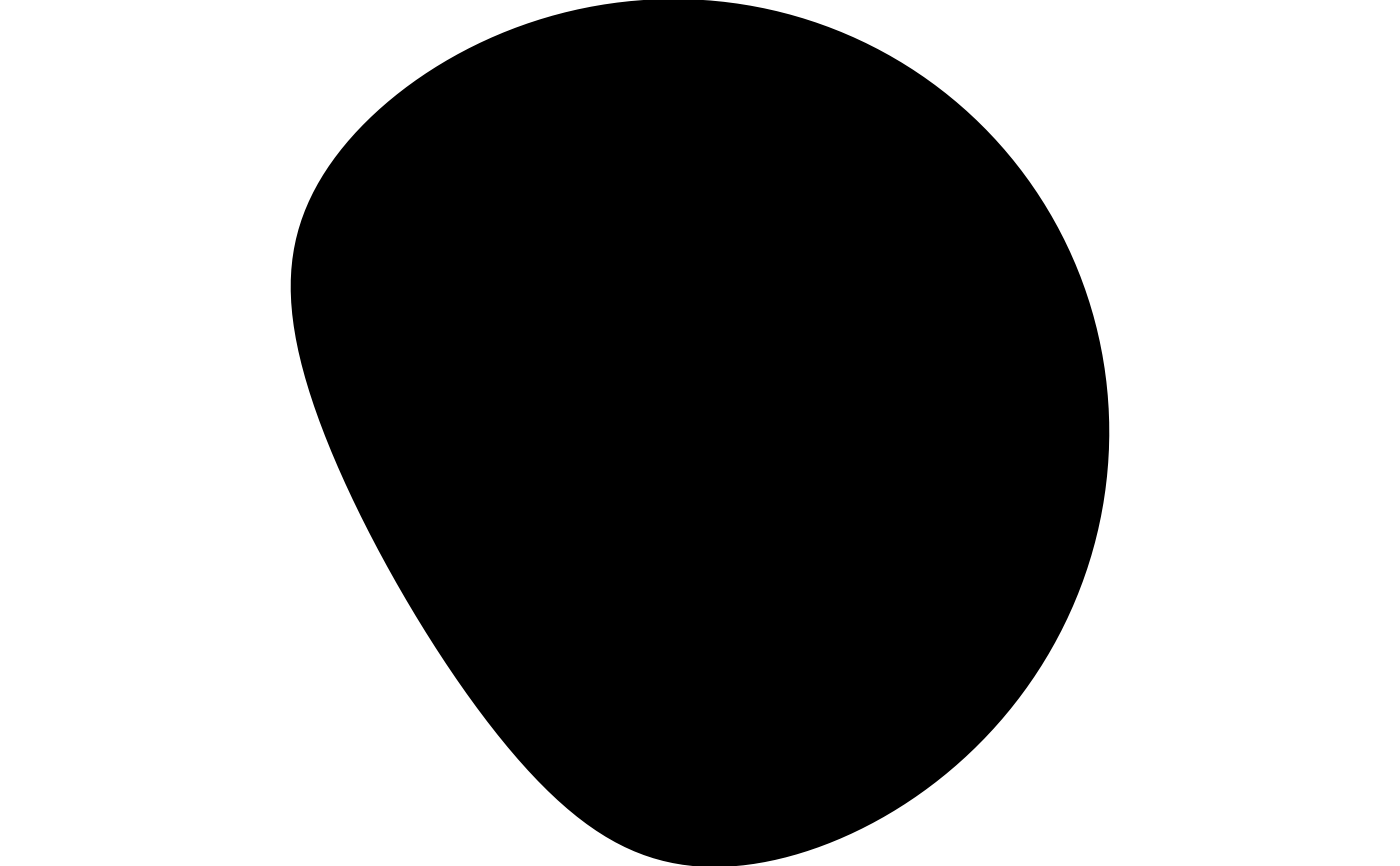
# a deterministic swirl: rotate each point by an angle that grows with
# its own distance from the origin. A shape centred at the origin
# (e.g. a plain shape_circle()) is rotationally symmetric about it, so
# every point shares the same distance and the swirl just rotates the
# whole shape rigidly -- offsetting the shape away from the origin
# gives points at varying distances instead, showing the effect
swirl <- function(x, y) {
r <- sqrt(x^2 + y^2)
theta <- atan2(y, x) + r * 1.5
list(x = r * cos(theta), y = r * sin(theta))
}
draw(shape_circle(x = 1, radius = 0.4, n = 200, trans = trans_fn(swirl)))
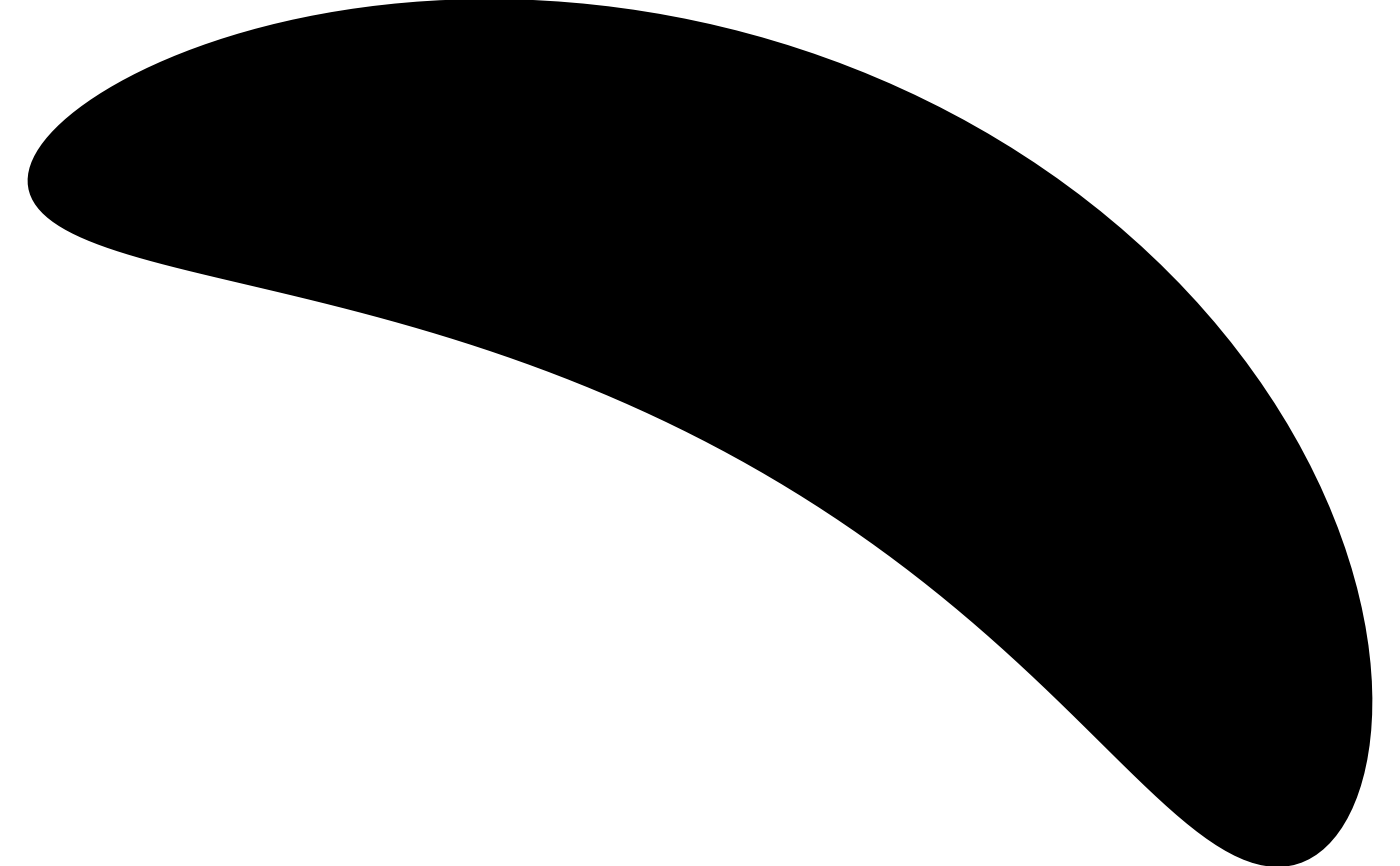 # a bulge: points near the origin are pushed outward more than points
# far from it. Offsetting the shape away from the origin (for the same
# reason as the swirl example above) means one side sits closer to the
# origin than the other, so the bulge dents that side outward more
bulge <- function(x, y) {
r <- sqrt(x^2 + y^2)
scale_factor <- 1 + 0.6 * exp(-4 * r^2)
list(x = x * scale_factor, y = y * scale_factor)
}
draw(shape_circle(x = 0.8, radius = 0.5, n = 200, trans = trans_fn(bulge)))
# a bulge: points near the origin are pushed outward more than points
# far from it. Offsetting the shape away from the origin (for the same
# reason as the swirl example above) means one side sits closer to the
# origin than the other, so the bulge dents that side outward more
bulge <- function(x, y) {
r <- sqrt(x^2 + y^2)
scale_factor <- 1 + 0.6 * exp(-4 * r^2)
list(x = x * scale_factor, y = y * scale_factor)
}
draw(shape_circle(x = 0.8, radius = 0.5, n = 200, trans = trans_fn(bulge)))
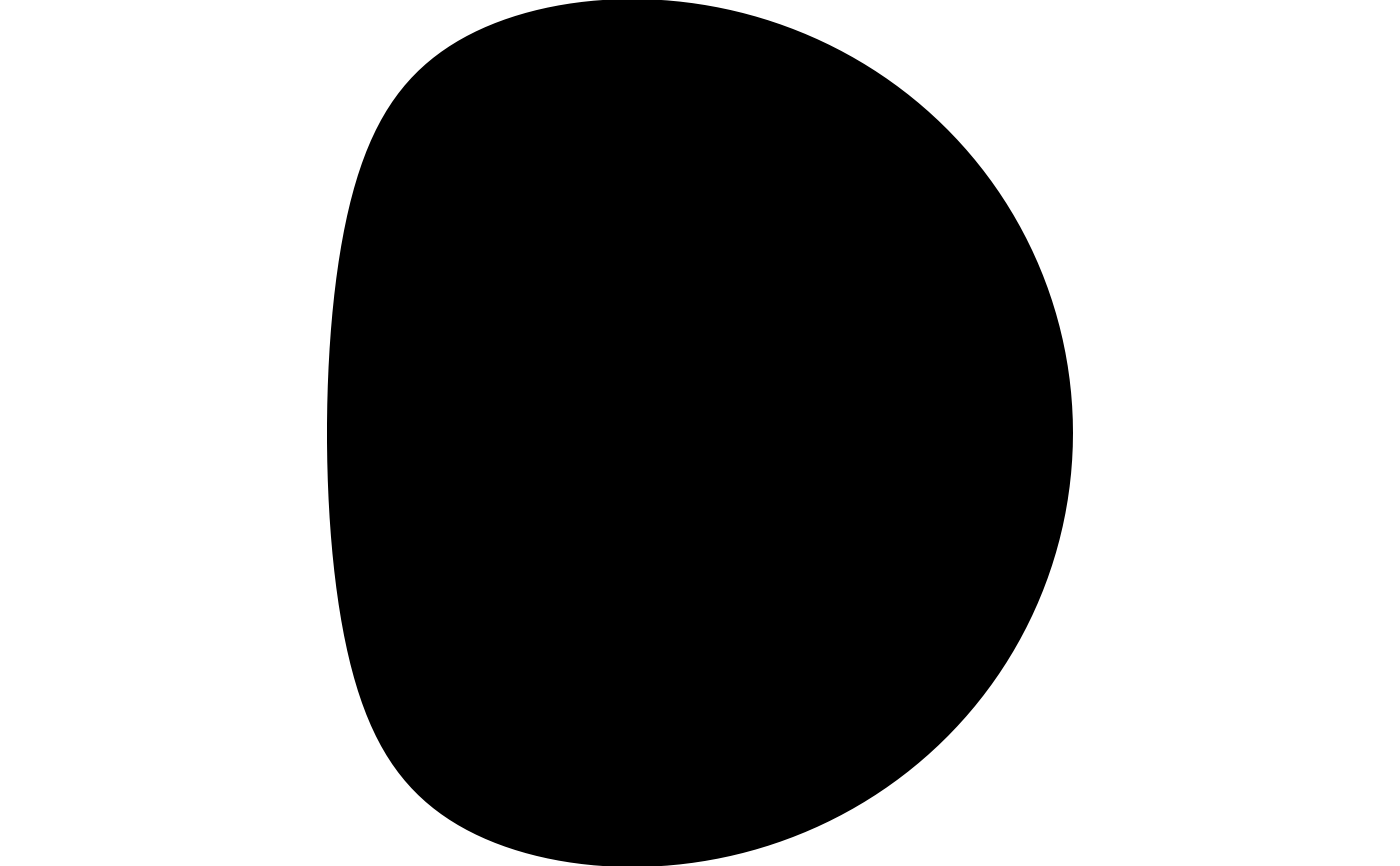 # combining a trans_fn with a trans (or a trans_warp) produces a
# trans_chain, applied in the order given by +
draw(shape_circle(
x = 0.8, radius = 0.5, n = 200,
trans = trans_fn(bulge) + trans_rotate(pi / 6)
))
# combining a trans_fn with a trans (or a trans_warp) produces a
# trans_chain, applied in the order given by +
draw(shape_circle(
x = 0.8, radius = 0.5, n = 200,
trans = trans_fn(bulge) + trans_rotate(pi / 6)
))