points_raw is shape_raw's "points"-geometry analog, and the first
concrete constructor to use geometry = "points" (previously reserved
on the dimensional reading "points"(0D)/"path"(1D)/"polygon"(2D),
but with no constructor exposing it – see .agents/PLAN.md). The user
supplies x/y coordinates directly, rendered as unconnected markers
rather than a connected outline or path.
points_raws() is a vectorized version of points_raw(). Since
x/y are themselves numeric vectors of point coordinates for a
single scatter, points_raws() takes them as a list() of numeric
vectors instead – one vector per scatter – which is most useful for
giving several distinct scatters different style arguments (e.g. a
different color each).
Usage
points_raw(x, y, id = NULL, trans = trans_identity(), ...)

points_raws(x, y, id = NULL, trans = trans_identity(), ...)
Arguments
- x, y
For
points_raw(), a numeric vector of x/y coordinates. Forpoints_raws(), alist()of such vectors instead – one vector per scatter.- id
For
points_raw(), an integer vector the same length asx/y, orNULL(the default). Forpoints_raws(), alist()of such vectors (orNULLs) instead, one per scatter. Inert either way – see Details.- trans
A trans object applied to the computed points. Default
trans_identity()(no transform).- ...
Arguments passed to
style().
Details
style@fill and every line-related style property (linewidth,
linetype, linejoin, lineend, linemitre) have no effect for
points_raw() – see drawable's geometry documentation and
geometry_grob()'s internal dispatch (R/draw.R) for why a "points"
geometry has no line to stroke and no interior to fill. Only style@color
is used, as the marker colour.
id (see xy's own id) is accepted and stored for consistency with
shape_raw()/curve_raw() and to round-trip through convert(), but
is otherwise inert here – grid::pointsGrob() has no sub-path
concept, consistent with fill already being inert for "points"
geometry.
Every other argument may be a plain vector, recycled against x/y
via purrr::pmap()'s own vctrs-based rules (any length-1 element is
broadcast to the common length; mismatched lengths greater than 1
raise an error). The result is a sketch containing one
points_raw() per list element/recycled row, rather than a single
drawable.
Examples
draw(points_raw(
x = seq(0, 1, length.out = 20),
y = sin(seq(0, 2 * pi, length.out = 20)) / 2 + 0.5,
color = "steelblue"
))
 # a random scatter, and the same points converted from a polygon's
# own outline (only style-related properties survive the round trip)
draw(points_raw(x = runif(200), y = runif(200)))
# a random scatter, and the same points converted from a polygon's
# own outline (only style-related properties survive the round trip)
draw(points_raw(x = runif(200), y = runif(200)))
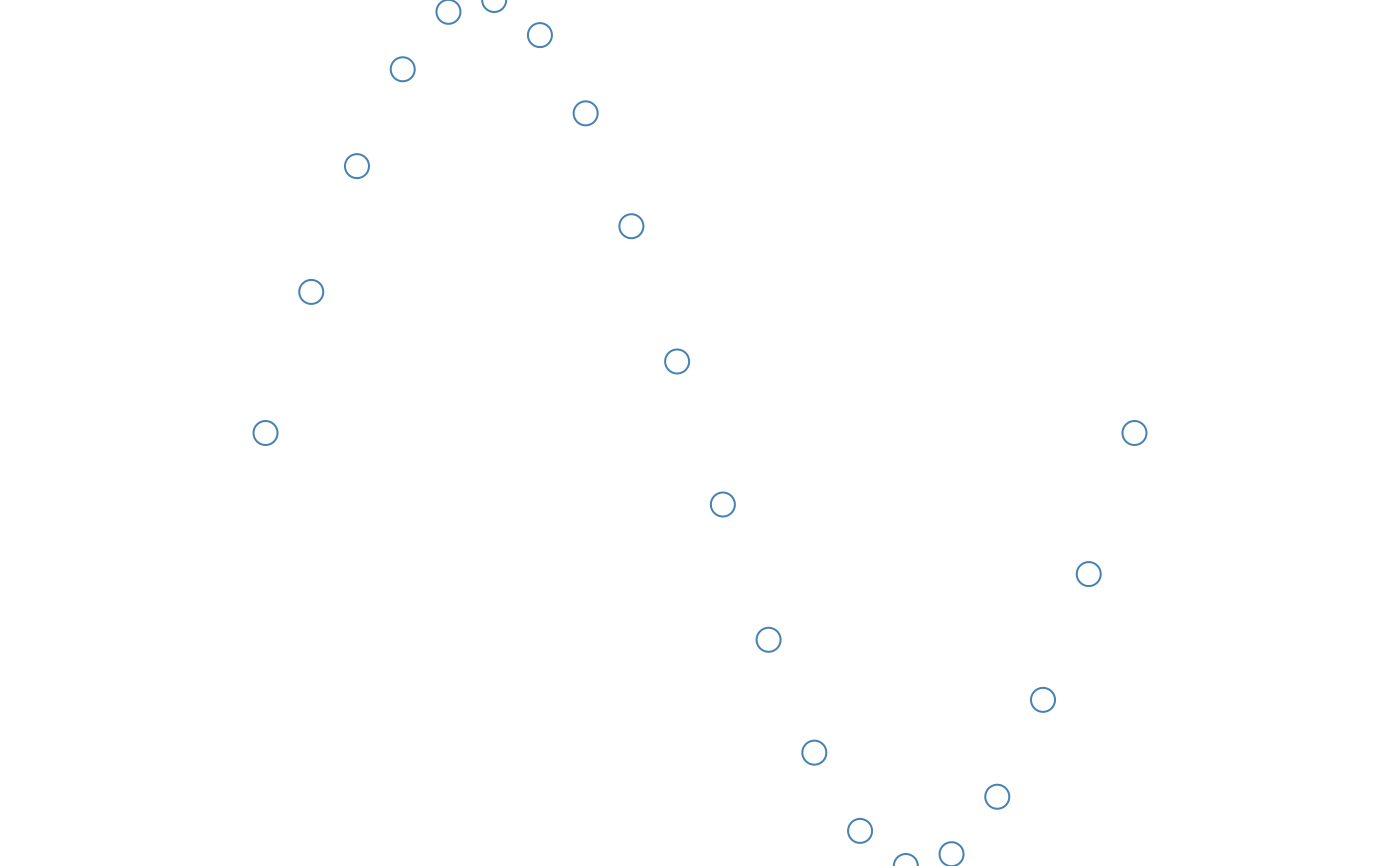
 draw(S7::convert(
shape_blob(radius = 1, distortion = noise_field(seed = 42)),
points_raw
))
draw(S7::convert(
shape_blob(radius = 1, distortion = noise_field(seed = 42)),
points_raw
))
 # points_raw() is pathlike, so effect_tremor() can wobble the scatter
draw(effect_tremor(
points_raw(x = seq(0, 1, length.out = 30), y = rep(0.5, 30)),
layers = 6L, jitter = 0.08
))
# points_raw() is pathlike, so effect_tremor() can wobble the scatter
draw(effect_tremor(
points_raw(x = seq(0, 1, length.out = 30), y = rep(0.5, 30)),
layers = 6L, jitter = 0.08
))
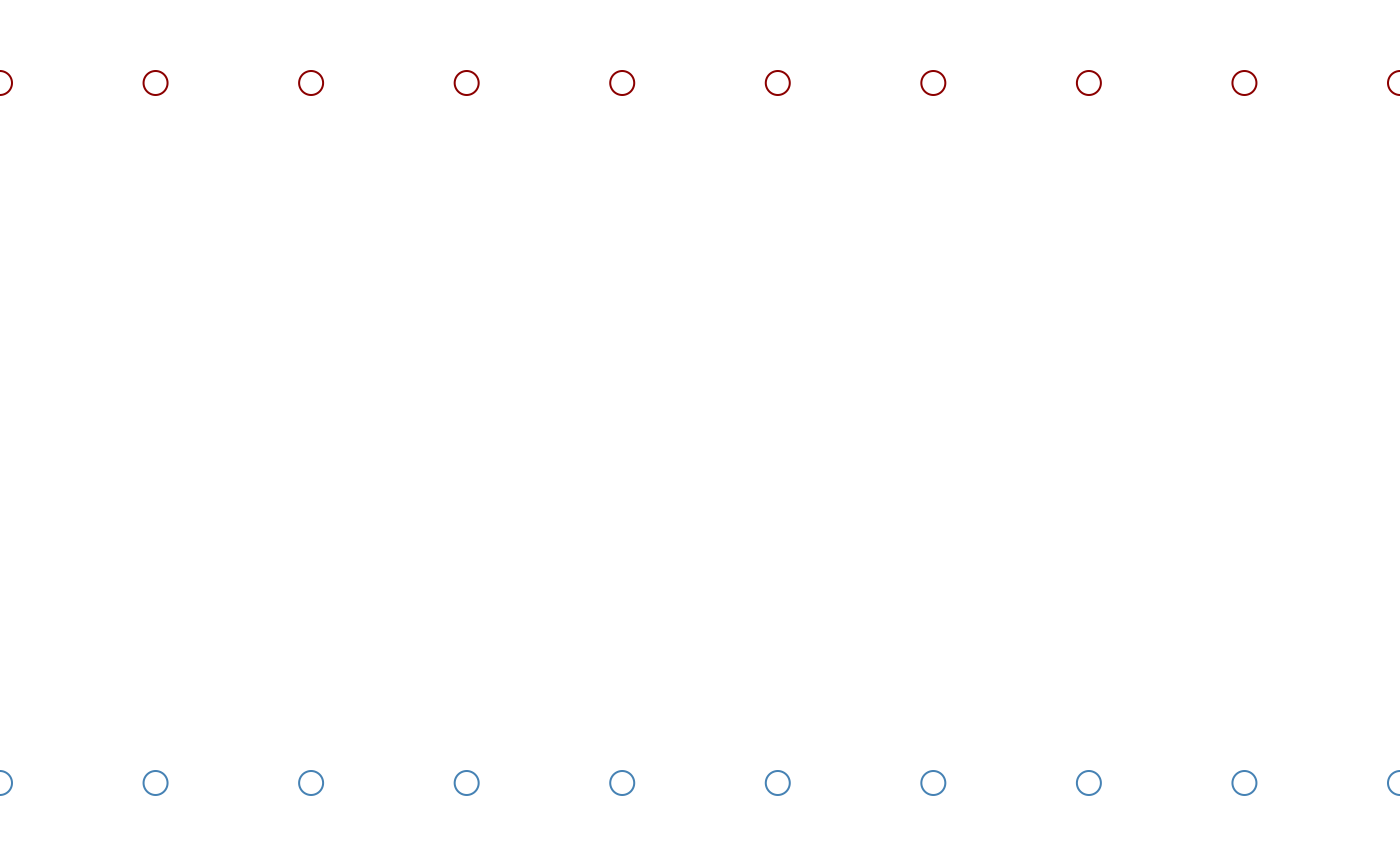
 draw(points_raws(
x = list(seq(0, 1, length.out = 10), seq(0, 1, length.out = 10)),
y = list(rep(0.25, 10), rep(0.75, 10)),
color = c("steelblue", "darkred")
))
draw(points_raws(
x = list(seq(0, 1, length.out = 10), seq(0, 1, length.out = 10)),
y = list(rep(0.25, 10), rep(0.75, 10)),
color = c("steelblue", "darkred")
))