Layer jittered copies of a drawable for a hand-drawn look
Source:R/effect_tremor.R
effect_tremor.Rdeffect_tremor() builds a group of layers such copies: each is a
copy of object (via S7::set_props()) with its x/y displaced by
smooth, seed-offset simplex noise sampled along the path's own
normalized arc-length.
Arguments
- object
A pathlike drawable (
@pathlike == TRUE, see drawable's docs), e.g.curve_line(),shape_stroke(),shape_bezier(). Every other property is preserved unchanged across layers.- layers
Number of independently-jittered copies to layer. Must be a positive integer. Default
4L.- jitter
Maximum displacement amplitude applied to each layer's
x/y. Must be non-negative. Default0.05.- jitter_frequency
Frequency of the simplex noise driving the jitter, sampled along the path's normalized arc-length – lower values give a slower, smoother wobble; higher values a jumpier one. Must be non-negative. Default
0.5.- seed
Integer seed for the jitter noise. Default
1L.
Value
A group containing layers drawables.
Details
No single drawable can express a hand-drawn ink/pencil look on its
own – what reads as hand-drawn is several independently wobbling
copies of the same nominal path layered on top of each other, not one
perfectly smooth line. This is the same ad hoc technique used, during
development, to add a wobbling pencil edge on top of a
shape_stroke()'s tapered outline, or to layer a plain curve_line()
into a shakier-looking line by itself.
Noise is sampled at each control point's own position along arc-length
(0 to 1), not at its raw x/y coordinates, so the jitter's shape
is independent of the path's own scale or aspect ratio – a long,
shallow path and a short, steep one with the same number of control
points get comparably-shaped wobble. Each layer's noise is
seed-offset from the last (seed + 2 * (i - 1) for the x
displacement, one more for y, following the same seed-offset
convention trans_warp()/twisted_path_points() already use for
their own independent-axis noise), so layers wobble independently
rather than moving in lockstep.
Because each layer is built with S7::set_props() from object
itself, every other property – style, width/distortion for a
shape_stroke(), trans, ... – carries over unchanged;
effect_tremor() only varies x/y across layers. Vary color_alpha
down and/or layers up (on object and via the layers argument,
respectively) for a denser, more overlapping pencil/ink texture.
See also
Other effects:
effect_bristle(),
effect_grain(),
effect_swatch()
Examples
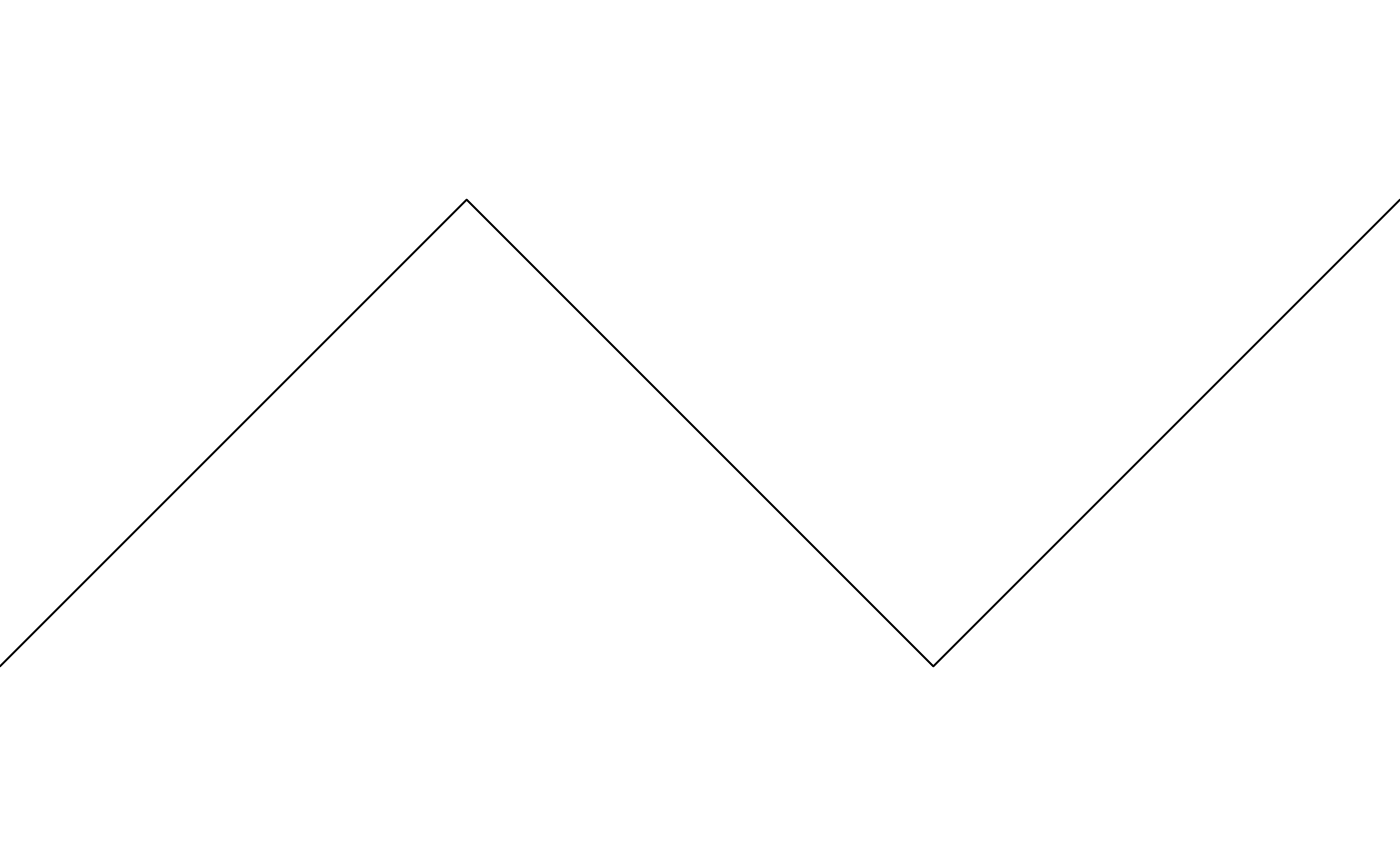
template <- curve_line(x = c(0, 1, 2, 3), y = c(0, 1, 0, 1))
faded <- curve_line(x = c(0, 1, 2, 3), y = c(0, 1, 0, 1), color_alpha = 0.4)
# before: a single crisp line
draw(template)
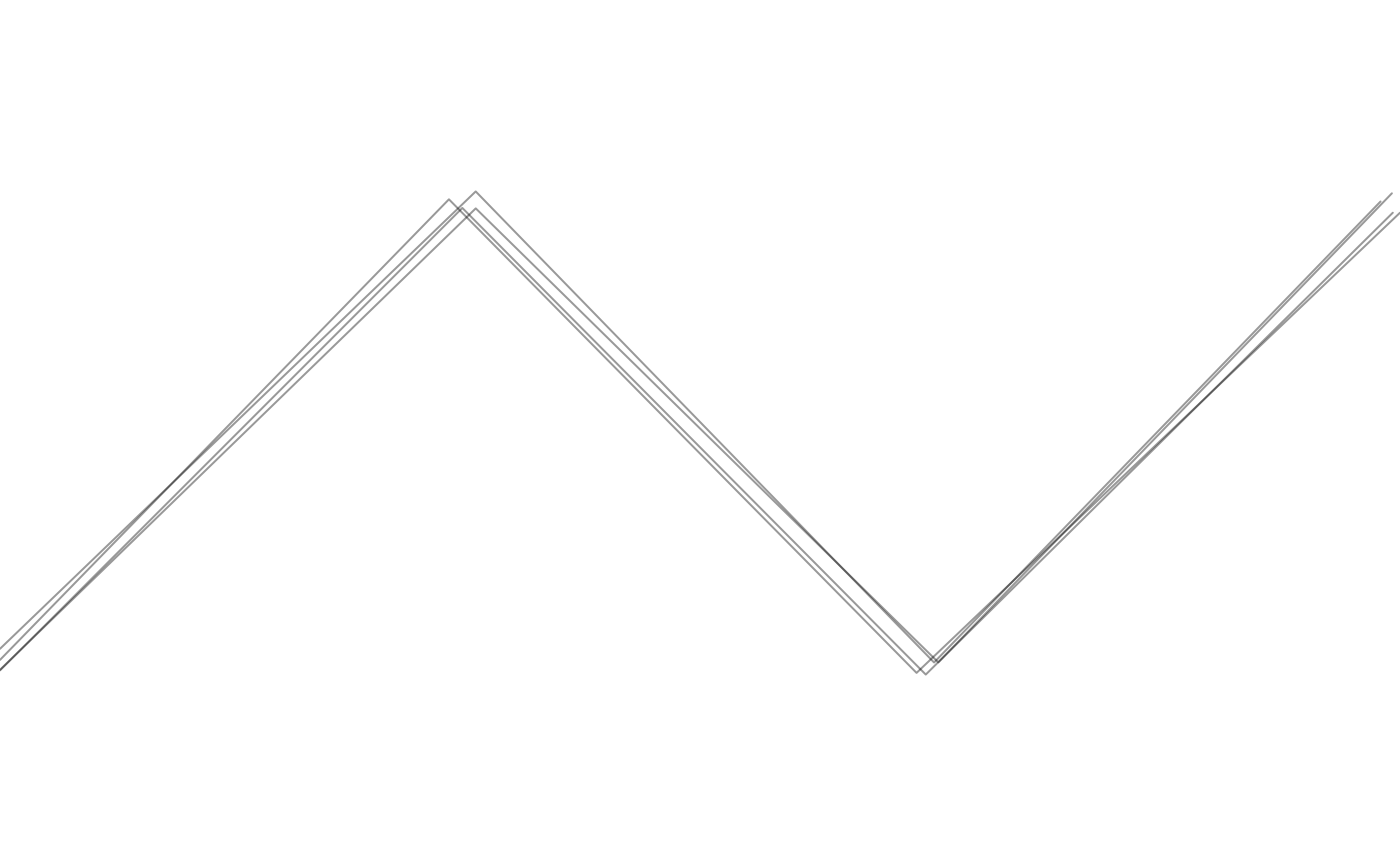
 # after: several jittered, faded copies read as hand-drawn
draw(effect_tremor(faded))
# after: several jittered, faded copies read as hand-drawn
draw(effect_tremor(faded))
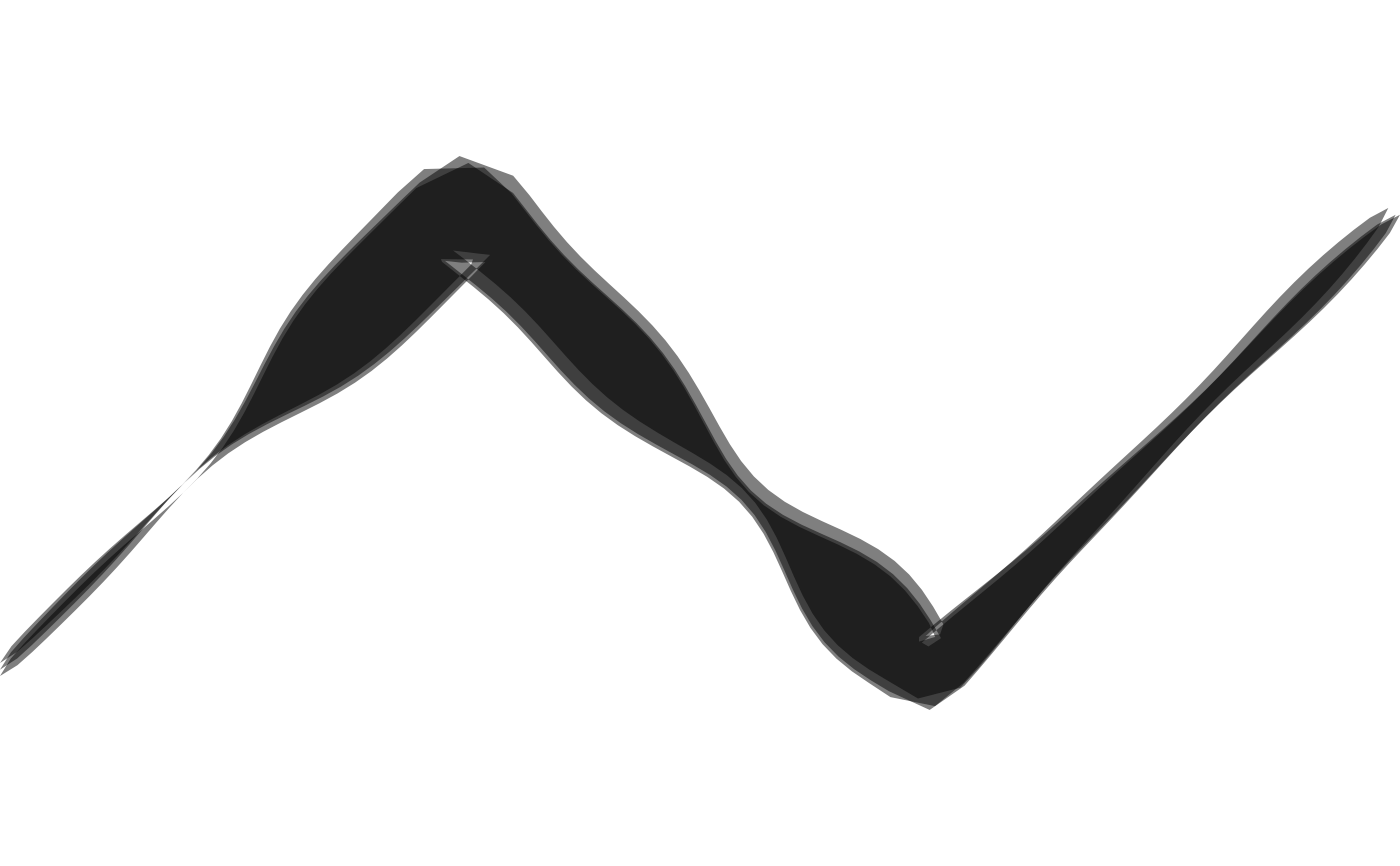
 draw(effect_tremor(
shape_stroke(
x = c(0, 1, 2, 3), y = c(0, 1, 0, 1),
width = 0.3, fill_alpha = 0.5, color = NA_character_
),
layers = 3L, jitter = 0.03
))
draw(effect_tremor(
shape_stroke(
x = c(0, 1, 2, 3), y = c(0, 1, 0, 1),
width = 0.3, fill_alpha = 0.5, color = NA_character_
),
layers = 3L, jitter = 0.03
))
 # more layers and higher jitter give a denser, shakier scribble
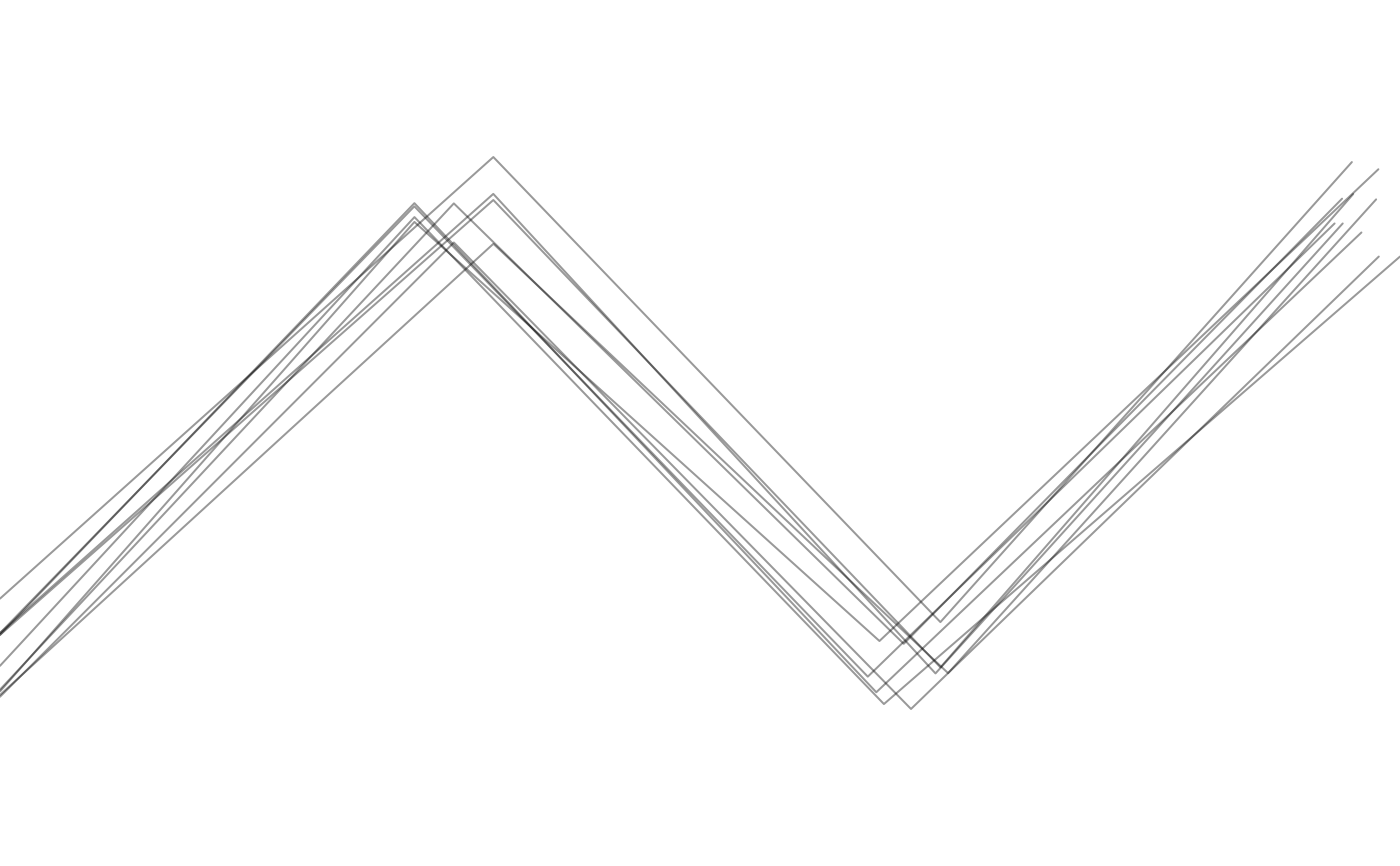
draw(effect_tremor(faded, layers = 10L, jitter = 0.15))
# more layers and higher jitter give a denser, shakier scribble
draw(effect_tremor(faded, layers = 10L, jitter = 0.15))