shape_wedge is a drawable defined by a centroid, a radius, and a
start/end angle (in radians): its outline is the centroid, followed by
n points along the circular arc from start to end.
shape_wedges() is a vectorized version of shape_wedge(): each
argument may be a vector, recycled against the others. The result is a
sketch containing one shape_wedge() per recycled row, rather than a
single drawable.
Usage
shape_wedge(
  x = 0,
  y = 0,
  radius = 1,
  inner_radius = 0,
  start = 0,
  end = pi/2,
  n = 100L,
  trans = trans_identity(),
  ...
)

shape_wedges(
  x = 0,
  y = 0,
  radius = 1,
  inner_radius = 0,
  start = 0,
  end = pi/2,
  n = 100L,
  trans = trans_identity(),
  ...
)
Arguments
- x, y
Centroid coordinates. Default
0.- radius
Radius. Must be non-negative. Default
1.- inner_radius
Inner radius. Must be non-negative and no greater than
radius. Default0(a pie-slice wedge, i.e. no inner arc; see Details for the ring-slice/annulus-segment shape a positive value gives instead).- start, end
Start/end angle of the arc, in radians. Default
0/pi / 2.- n
Number of points used to approximate the arc. Must be at least
2. Default100L.- trans
A trans object applied to the shape's computed points. Default
trans_identity()(no transform).- ...
Arguments passed to
style().
Details
grid's own polygon closing then draws the final straight edge back from
the arc's last point to the centroid, giving the familiar pie-slice/wedge
shape. curve_arc() is the arc alone, with no centroid vertex or fill.
inner_radius (default 0) turns the pie slice into a ring slice (an
annulus segment): when greater than 0, the centroid vertex is dropped
entirely, and the outline instead traces the outer arc from start to
end followed by a second, inner arc of radius inner_radius swept back
from end to start – grid's own polygon closing then draws the
final straight edge back to the outer arc's first point, giving a
four-sided (two arcs, two straight radial edges) ring-slice outline
rather than a pie slice's three-sided one (two straight edges meeting at
the centroid, one arc). inner_radius = 0 (the default) recovers the
original pie-slice outline exactly, since a zero-radius "inner arc"
would otherwise degenerate to the centroid repeated n times.
Recycling uses purrr::pmap()'s own vctrs-based rules: any length-1
element is broadcast to the common length; mismatched lengths greater
than 1 raise an error.
Examples
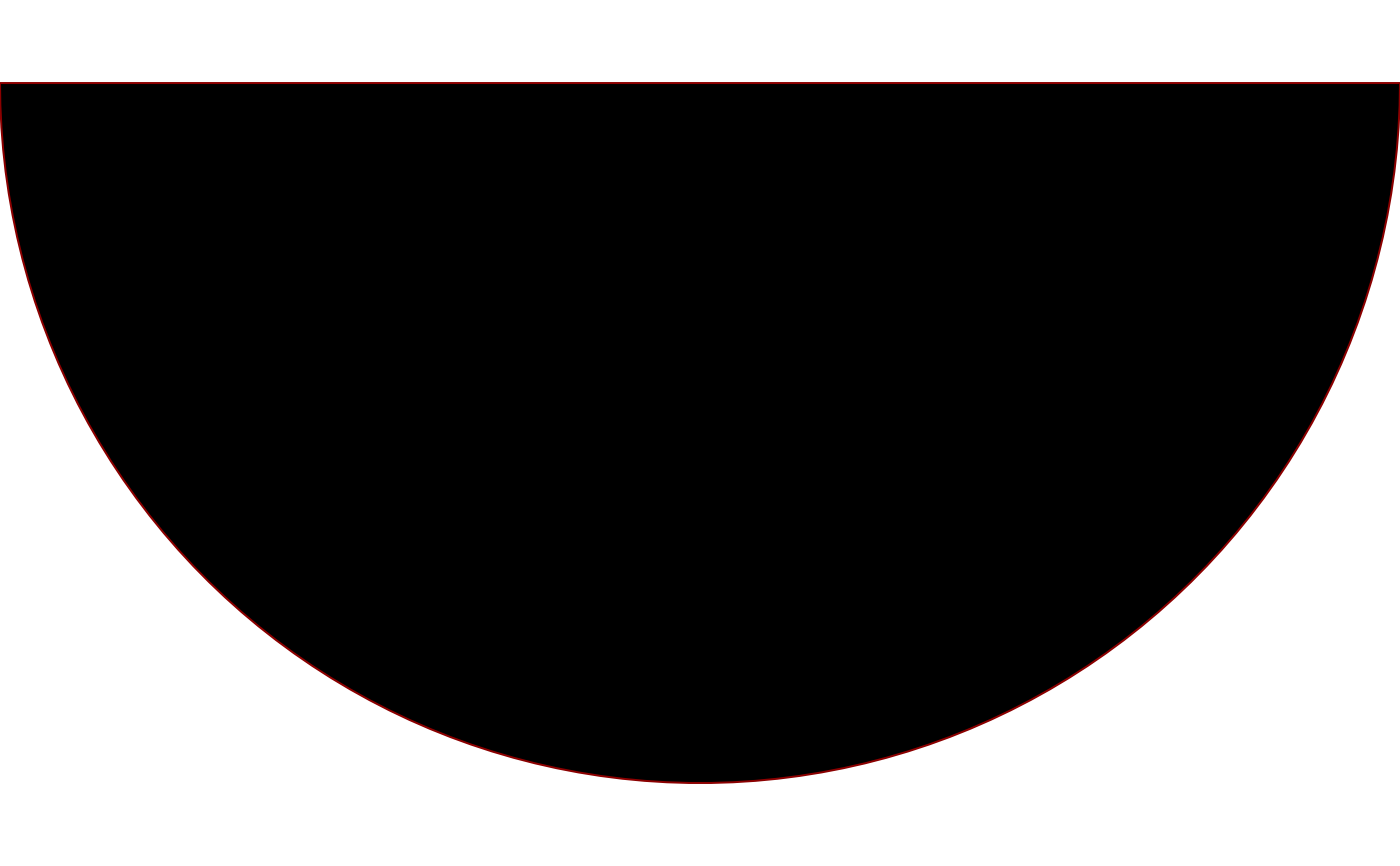
draw(shape_wedge(start = 0, end = pi / 2))
 draw(shape_wedge(
x = 1,
y = 1,
radius = 0.5,
start = pi,
end = 2 * pi,
color = "darkred"
))
draw(shape_wedge(
x = 1,
y = 1,
radius = 0.5,
start = pi,
end = 2 * pi,
color = "darkred"
))
 # a nearly-full sweep gives a pac-man-like shape; the arc always closes
# straight back to the centroid
draw(shape_wedge(start = 0, end = 1.9 * pi, fill = "goldenrod"))
# a nearly-full sweep gives a pac-man-like shape; the arc always closes
# straight back to the centroid
draw(shape_wedge(start = 0, end = 1.9 * pi, fill = "goldenrod"))
 # inner_radius > 0 gives a ring slice (annulus segment) instead of a
# pie slice -- no centroid vertex, a hole in the middle
draw(shape_wedge(
radius = 1, inner_radius = 0.6, start = 0, end = 1.5 * pi,
fill = "steelblue"
))
# inner_radius > 0 gives a ring slice (annulus segment) instead of a
# pie slice -- no centroid vertex, a hole in the middle
draw(shape_wedge(
radius = 1, inner_radius = 0.6, start = 0, end = 1.5 * pi,
fill = "steelblue"
))
 # a full sweep (start = 0, end = 2 * pi) with inner_radius > 0 gives a
# complete ring/annulus
draw(shape_wedge(radius = 1, inner_radius = 0.7, start = 0, end = 2 * pi))
# a full sweep (start = 0, end = 2 * pi) with inner_radius > 0 gives a
# complete ring/annulus
draw(shape_wedge(radius = 1, inner_radius = 0.7, start = 0, end = 2 * pi))
 draw(shape_wedges(start = 0, end = seq(pi / 2, 2 * pi, length.out = 3)))
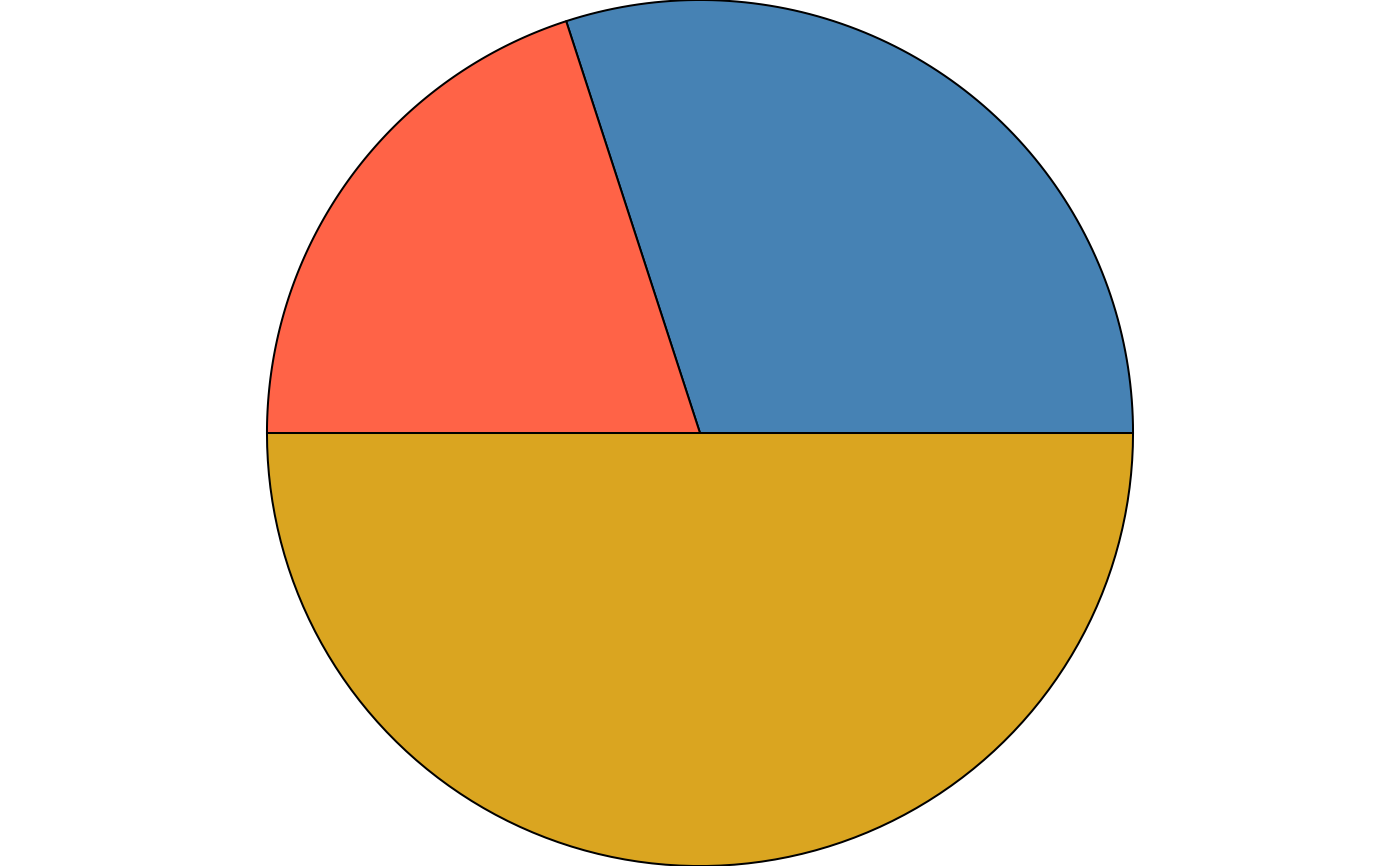
 # a pie chart: adjacent wedges sharing a centroid, one slice per value
value <- c(30, 20, 50)
cum <- c(0, cumsum(value)) / sum(value) * 2 * pi
draw(shape_wedges(
start = cum[-length(cum)], end = cum[-1],
fill = c("steelblue", "tomato", "goldenrod")
))
# a pie chart: adjacent wedges sharing a centroid, one slice per value
value <- c(30, 20, 50)
cum <- c(0, cumsum(value)) / sum(value) * 2 * pi
draw(shape_wedges(
start = cum[-length(cum)], end = cum[-1],
fill = c("steelblue", "tomato", "goldenrod")
))
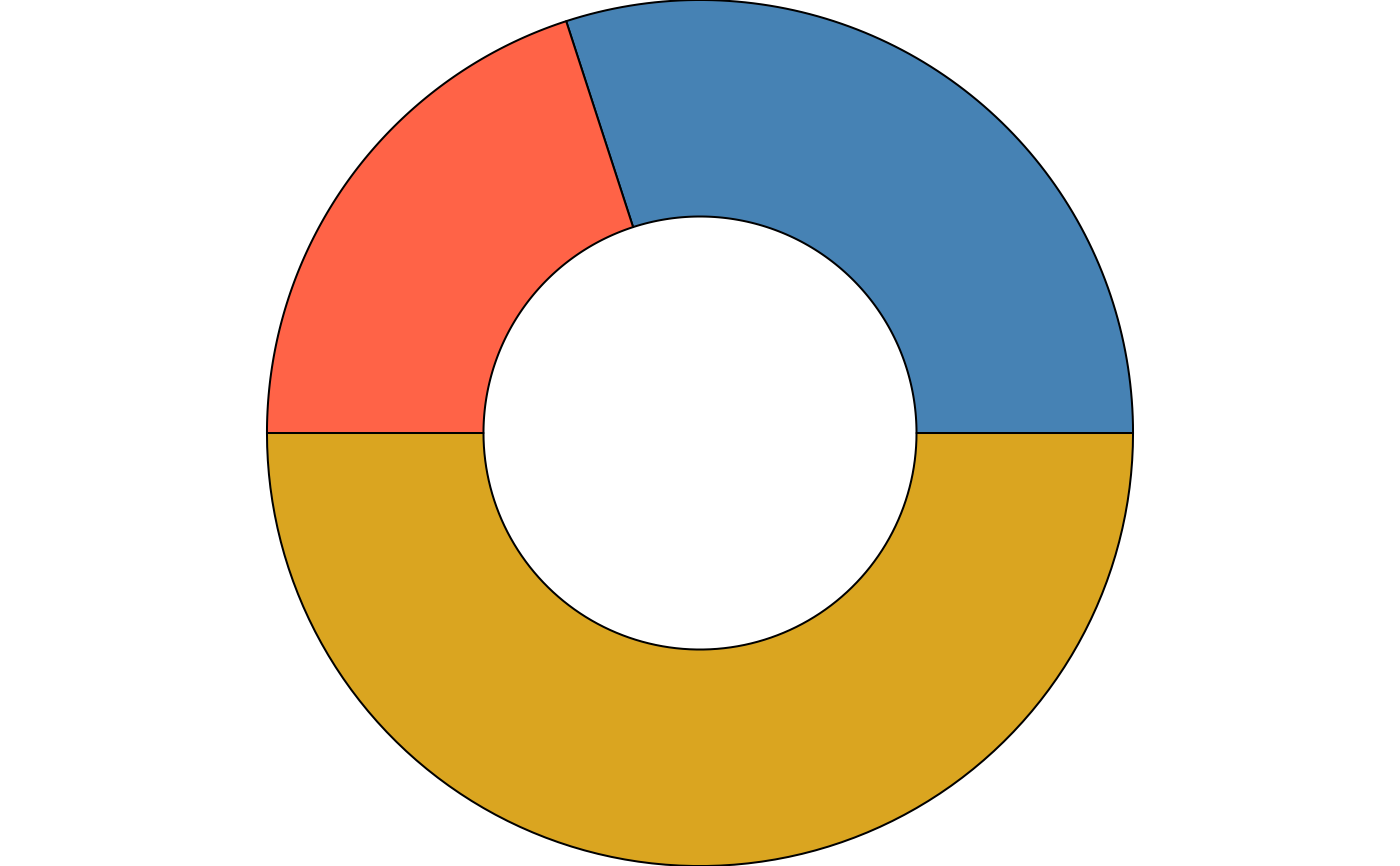
 # a donut chart: the same idea, with inner_radius > 0
draw(shape_wedges(
inner_radius = 0.5,
start = cum[-length(cum)], end = cum[-1],
fill = c("steelblue", "tomato", "goldenrod")
))
# a donut chart: the same idea, with inner_radius > 0
draw(shape_wedges(
inner_radius = 0.5,
start = cum[-length(cum)], end = cum[-1],
fill = c("steelblue", "tomato", "goldenrod")
))