shape_ribbon is a drawable polygon that follows a straight line
between (x, y) and (xend, yend), with a width that tapers at both
ends and varies along its length according to simplex noise.
shape_ribbons() is a vectorized version of shape_ribbon(): each
argument may be a vector, recycled against the others via
purrr::pmap()'s own vctrs-based rules. The result is a
sketch containing one shape_ribbon() per recycled row, rather
than a single drawable.
Usage
shape_ribbon(
  x = 0,
  y = 0,
  xend = 1,
  yend = 1,
  width = 0.2,
  n = 100L,
  distortion = noise_field(),
  trans = trans_identity(),
  ...
)

shape_ribbons(
  x = 0,
  y = 0,
  xend = 1,
  yend = 1,
  width = 0.2,
  n = 100L,
  distortion = noise_field(),
  trans = trans_identity(),
  ...
)
Arguments
- x, y
Start point. Default
0.- xend, yend
End point. Default
1.- width
Maximum width. Must be non-negative. Default
0.2.- n
Number of points used along the path. Default
100L.- distortion
A noise_field controlling the width modulation. Default
noise_field().- trans
A trans object applied to the shape's computed points. Default
trans_identity()(no transform).- ...
Arguments passed to
style().
Details
Any length-1 element is broadcast to the common length; mismatched
lengths greater than 1 raise an error. A shared distortion
noise_field is automatically recycled across every ribbon; pass a
list() of several different noise_fields instead to vary it per
ribbon.
Examples
draw(shape_ribbon(x = 0, y = 0, xend = 1, yend = 1, width = 0.3))
 # a higher-frequency distortion modulates width more rapidly along the
# ribbon's length, giving a more textured/organic edge
draw(shape_ribbon(
x = 0, y = 0, xend = 1, yend = 1, width = 0.3,
distortion = noise_field(frequency = 8, seed = 99)
))
# a higher-frequency distortion modulates width more rapidly along the
# ribbon's length, giving a more textured/organic edge
draw(shape_ribbon(
x = 0, y = 0, xend = 1, yend = 1, width = 0.3,
distortion = noise_field(frequency = 8, seed = 99)
))
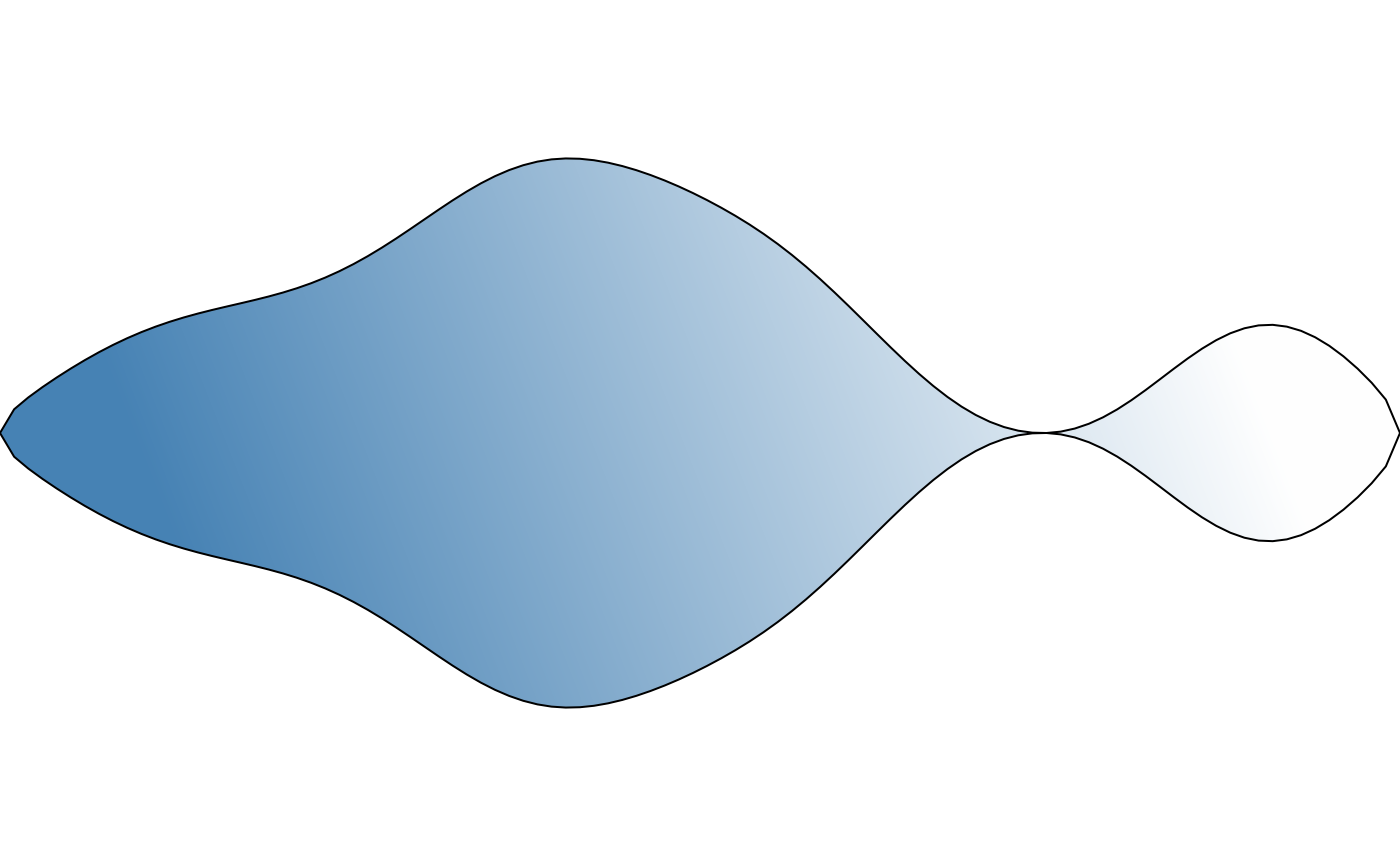
 draw(shape_ribbon(
x = 0, y = 0, xend = 2, yend = 0, width = 0.4,
fill = fill_gradient(color = c("steelblue", "white"))
))
draw(shape_ribbon(
x = 0, y = 0, xend = 2, yend = 0, width = 0.4,
fill = fill_gradient(color = c("steelblue", "white"))
))
 draw(shape_ribbons(x = 1:3, y = 0, xend = 2:4, yend = 1, width = 0.3))
 # a fan of ribbons radiating from the origin
angle <- seq(0, 2 * pi, length.out = 13)[-13]
draw(shape_ribbons(
x = 0,
y = 0,
xend = cos(angle),
yend = sin(angle),
width = 0.1
))
# a fan of ribbons radiating from the origin
angle <- seq(0, 2 * pi, length.out = 13)[-13]
draw(shape_ribbons(
x = 0,
y = 0,
xend = cos(angle),
yend = sin(angle),
width = 0.1
))