curve_scribble is a drawable whose path is a single random wandering
line – a random finite sum of sine harmonics – built from the same
internal scribble_lines() generator that fill_scribble() uses to
texture a tile's interior, but scaled here into an arbitrary bounding box
on the sketch's own coordinate plane rather than tiled inside a fill
pattern. Where fill_scribble() scatters several such lines across a
repeating tile as a texture, curve_scribble() draws exactly one as a
standalone open curve.
curve_scribbles() is a vectorized version of curve_scribble():
each argument may be a vector, recycled against the others via
purrr::pmap()'s own vctrs-based rules (any length-1 element is
broadcast to the common length; mismatched lengths greater than 1
raise an error).
Usage
curve_scribble(
  x = 0,
  y = 0,
  width = 1,
  height = 1,
  direction = "horizontal",
  n_harmonics = 3L,
  amplitude = 0.35,
  n = 200L,
  seed = 1L,
  trans = trans_identity(),
  ...
)

curve_scribbles(
  x = 0,
  y = 0,
  width = 1,
  height = 1,
  direction = "horizontal",
  n_harmonics = 3L,
  amplitude = 0.35,
  n = 200L,
  seed = 1L,
  trans = trans_identity(),
  ...
)
Arguments
- x, y
Coordinates of the curve's origin. Default
0.- width, height
Extent of the curve's bounding box along/across its direction of travel. Must be positive. Default
1.- direction
Either
"horizontal"(the curve runs left-right) or"vertical"(top-bottom). Default"horizontal".- n_harmonics
Number of sine harmonics summed to build the curve. Must be a positive integer. Default
3L.- amplitude
Maximum total wiggle amplitude, as a fraction of
height(fordirection = "horizontal") orwidth(for"vertical"), split acrossn_harmonics. Must be a non-negative number. Default0.35.- n
Number of points sampled along the curve. Must be a positive integer of at least
2L. Default200L.- seed
Integer seed for the random harmonics. Default
1L.- trans
A trans object applied to the curve's computed points. Default
trans_identity()(no transform).- ...
Arguments passed to
style().
Details
The underlying line is generated in (along, across) form, along
running from 0 to 1 and across wandering around a random baseline
near 0.5 (see scribble_lines()'s own details for why this
particular construction was chosen – periodicity, needed for tiling,
is irrelevant here). x/y place the curve's origin, and width/
height scale it: for direction = "horizontal" (the default), along
maps to x + along * width and across to y + across * height, so
the curve runs left-to-right; for direction = "vertical", the mapping
swaps (along maps to y, across to x), so the curve runs
bottom-to-top instead.
style@fill has no effect for curve_scribble() – see drawable's
geometry documentation for why "path" geometries have no interior to
fill. Passing fill via ... is still accepted (it's simply ignored at
draw time), since style() is shared across every geometry.
Varying seed per curve is usually what makes several scribbles look
distinct from each other. The result is a sketch containing one
curve_scribble() per recycled row, rather than a single drawable.
See also
Other 1D curves:
curve_arc(),
curve_bezier(),
curve_line(),
curve_raw(),
curve_spiral(),
curve_twist()
Examples
draw(curve_scribble(width = 2, height = 0.5, seed = 5591))
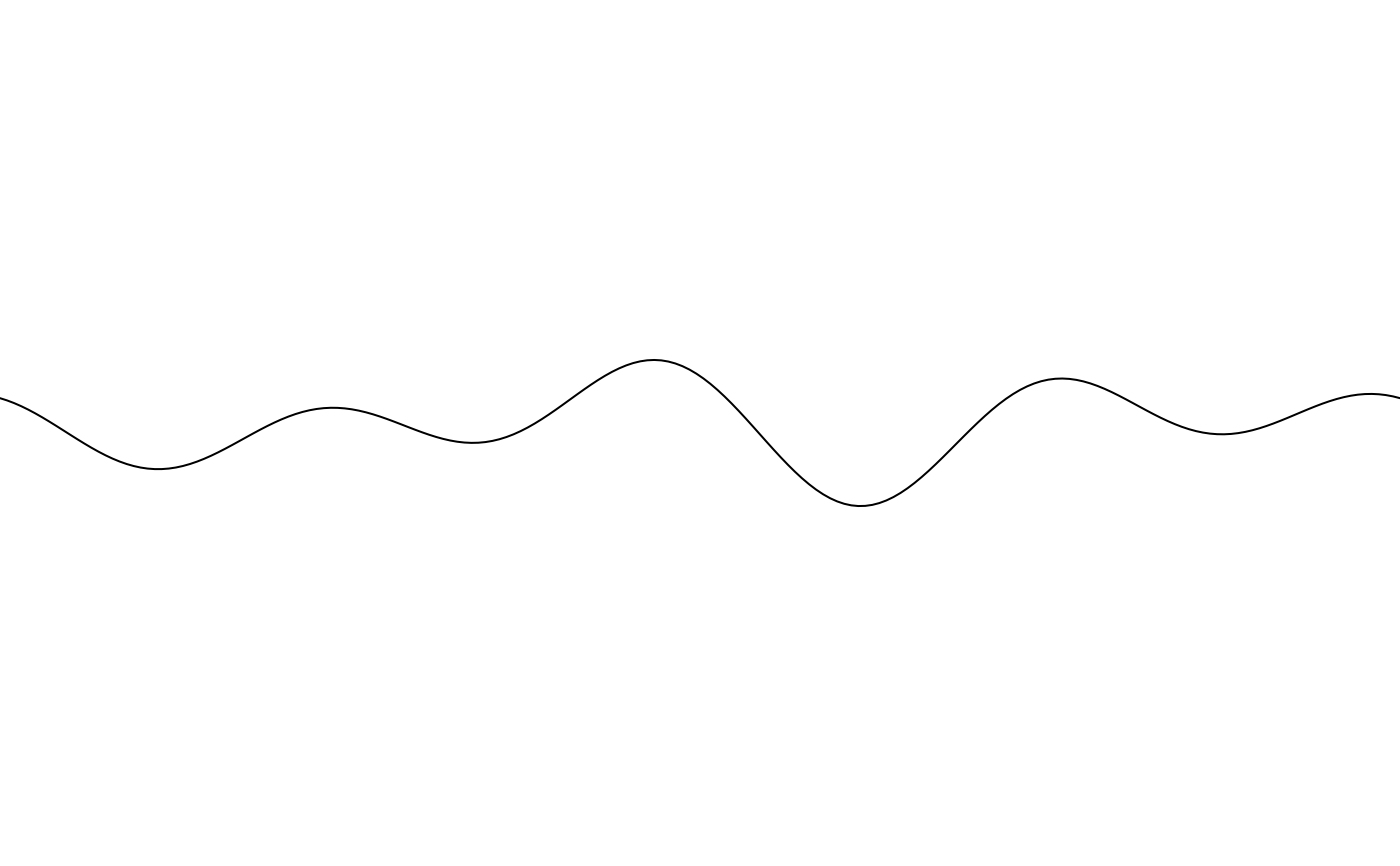 # more harmonics and higher amplitude give a more agitated wiggle
draw(curve_scribble(
width = 2, height = 0.5, n_harmonics = 8, amplitude = 0.6, seed = 5591
))
# more harmonics and higher amplitude give a more agitated wiggle
draw(curve_scribble(
width = 2, height = 0.5, n_harmonics = 8, amplitude = 0.6, seed = 5591
))
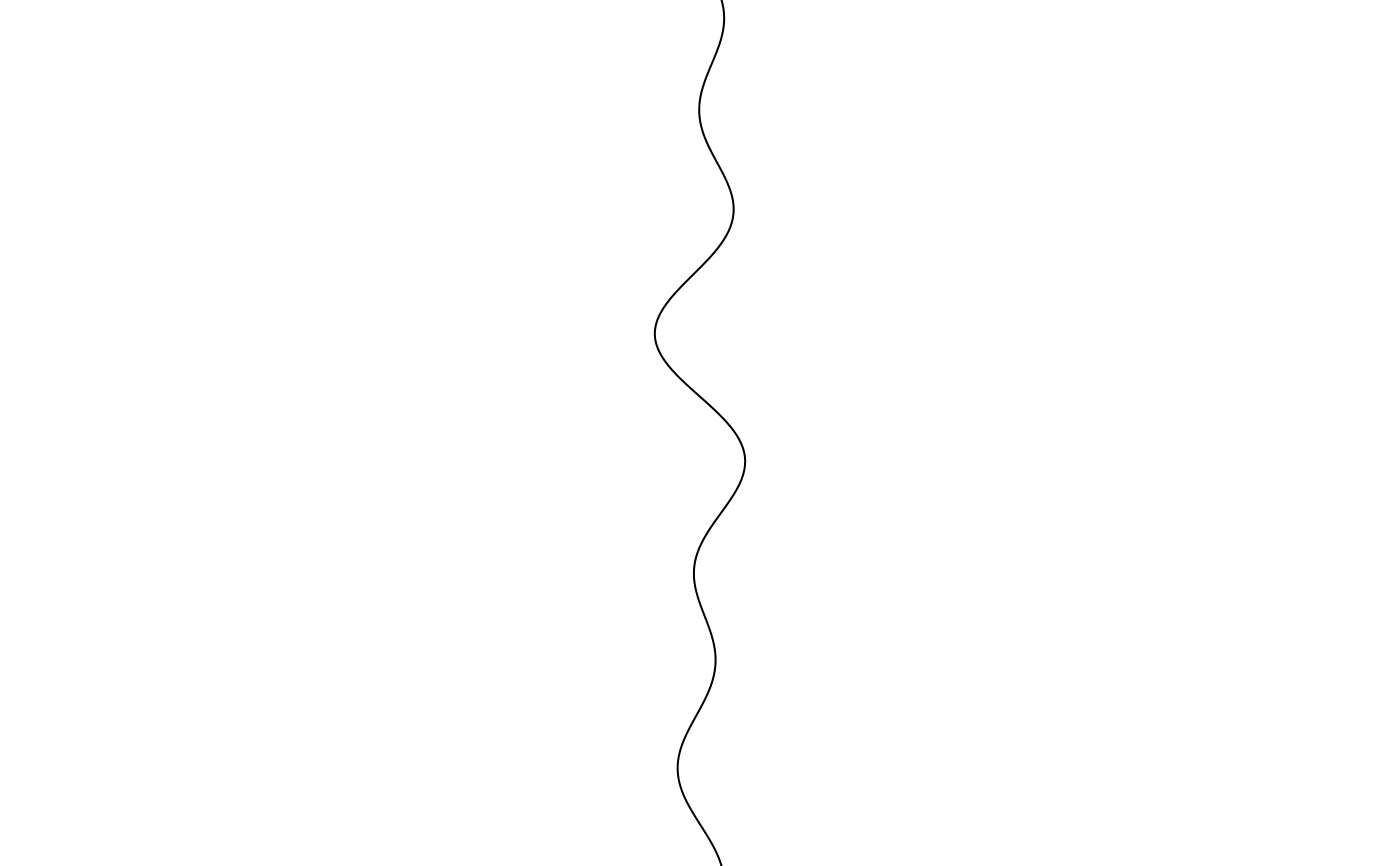
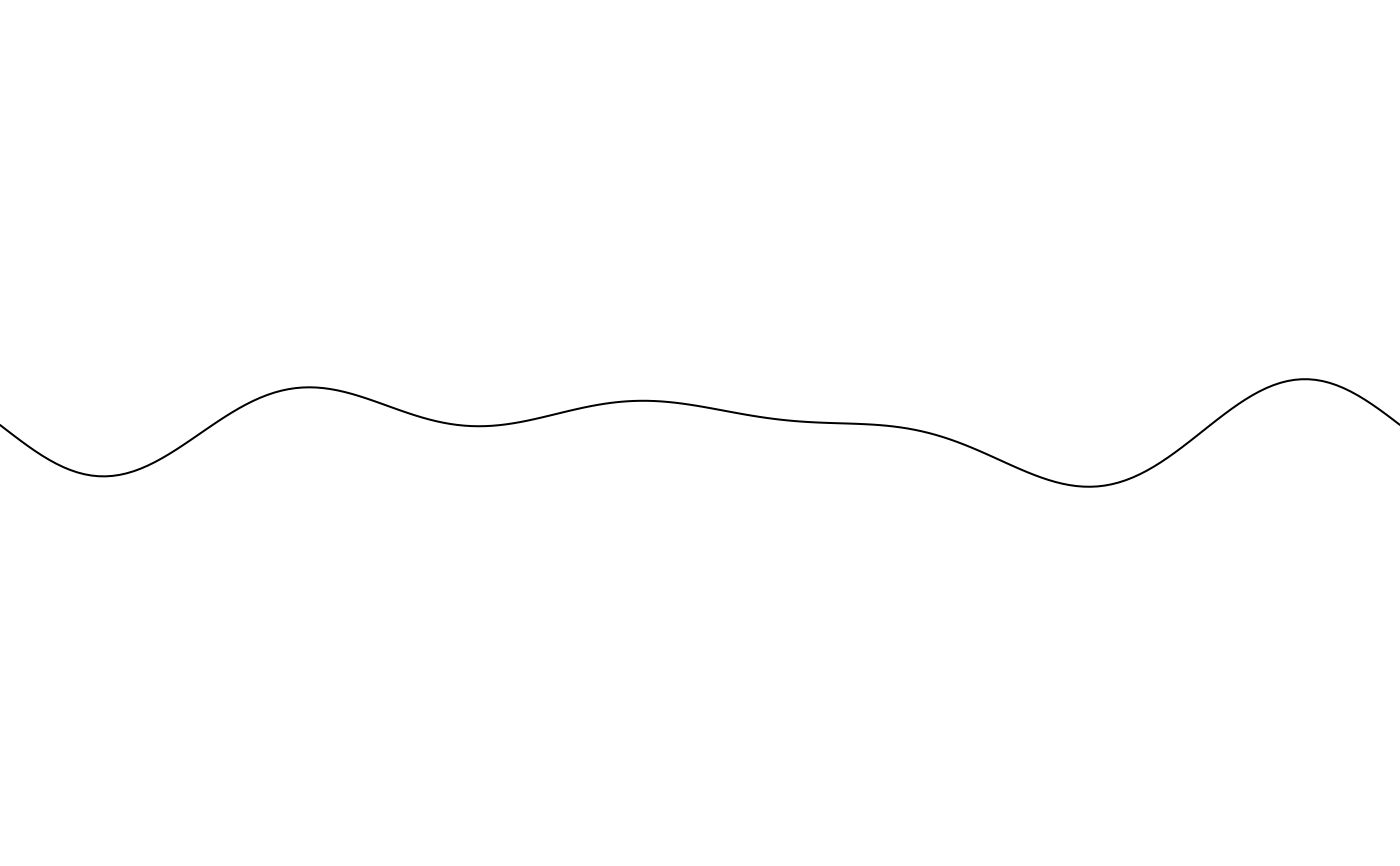 # direction = "vertical" runs the curve bottom-to-top instead
draw(curve_scribble(
width = 0.5, height = 2, direction = "vertical", seed = 5591
))
# direction = "vertical" runs the curve bottom-to-top instead
draw(curve_scribble(
width = 0.5, height = 2, direction = "vertical", seed = 5591
))
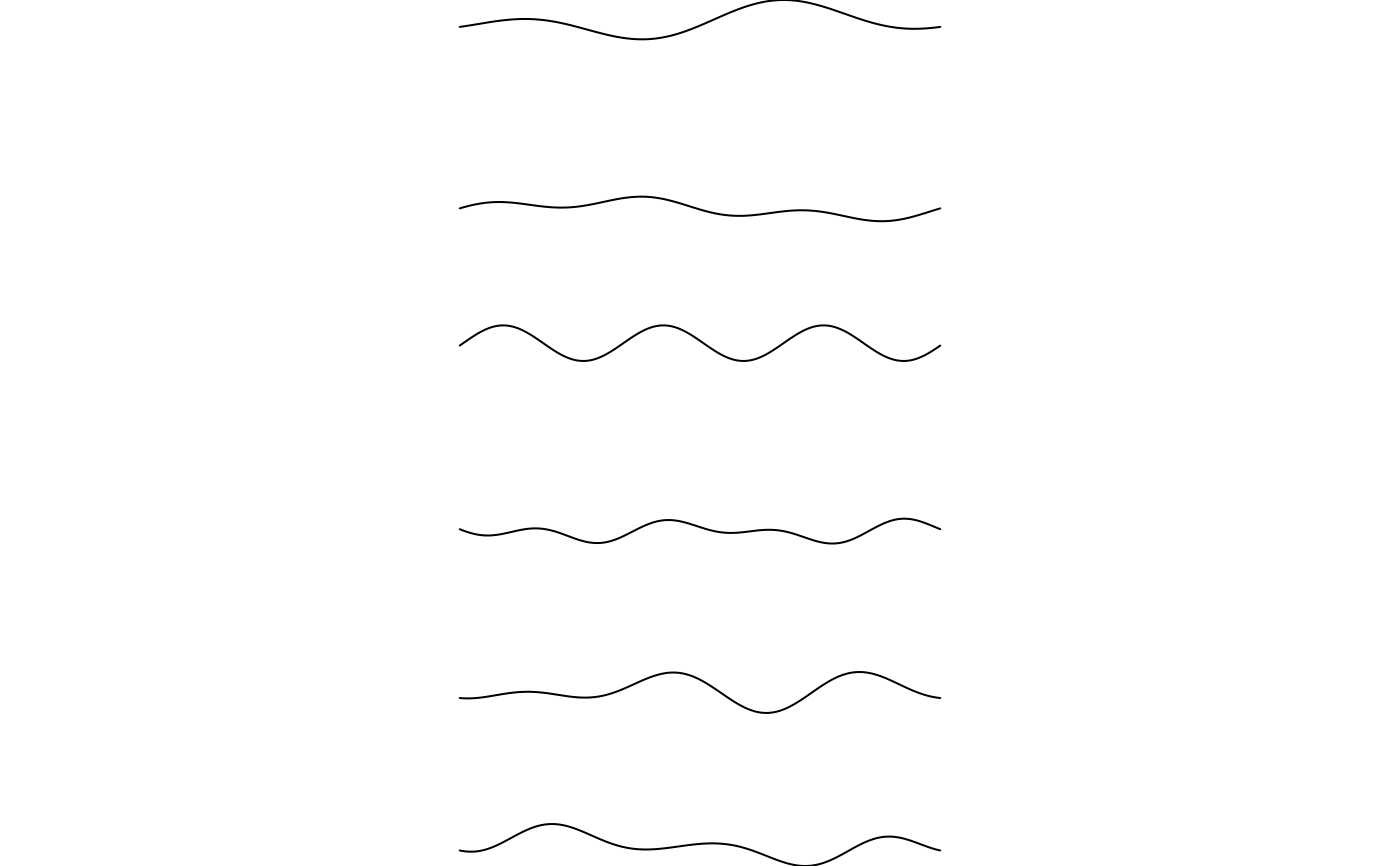
 draw(curve_scribbles(x = 1:3, width = 0.8, height = 0.5, seed = 1:3))
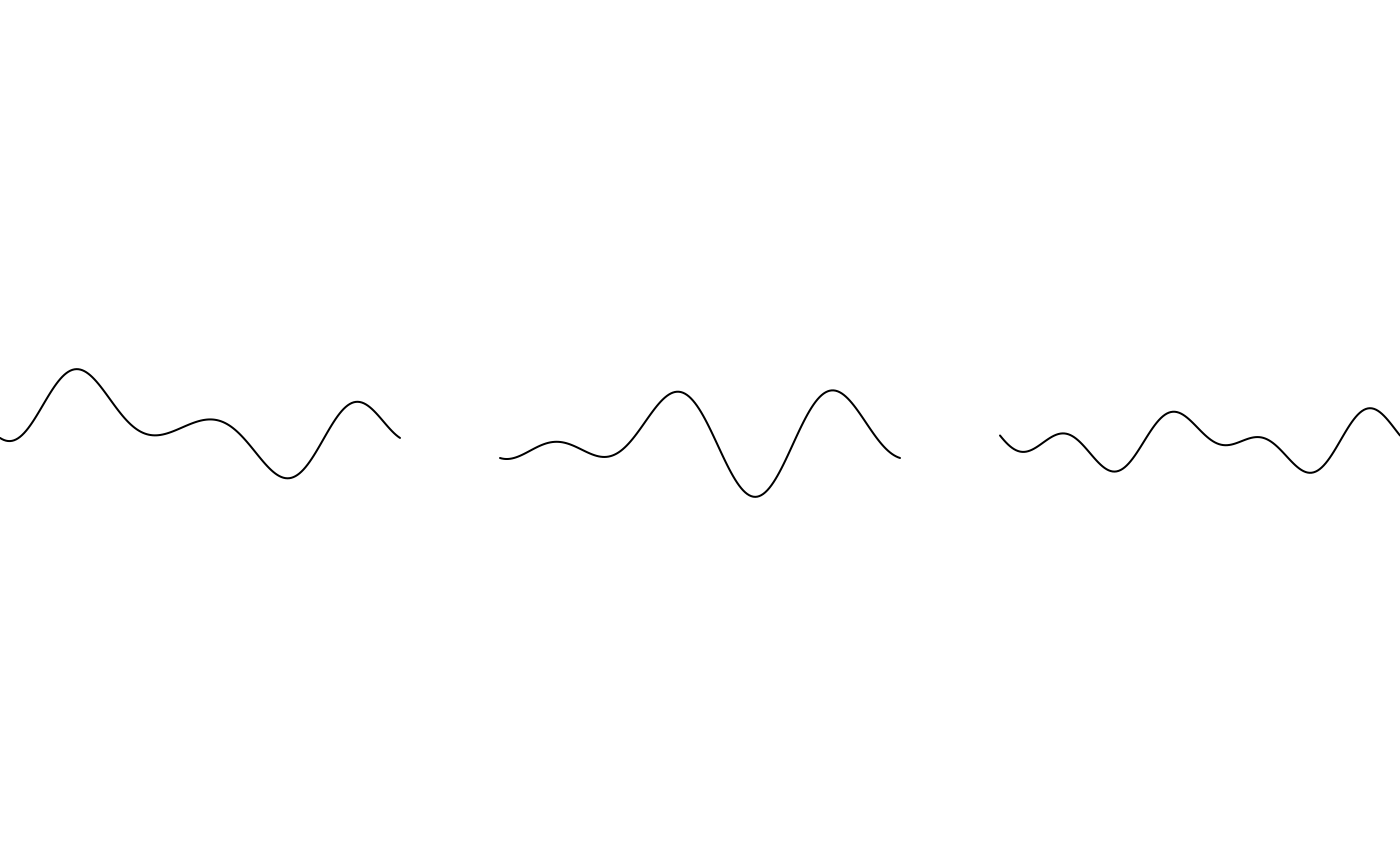 # stacked scribbles, like several strands of hatching
draw(curve_scribbles(y = 1:6, width = 3, height = 0.6, seed = 1:6))
# stacked scribbles, like several strands of hatching
draw(curve_scribbles(y = 1:6, width = 3, height = 0.6, seed = 1:6))