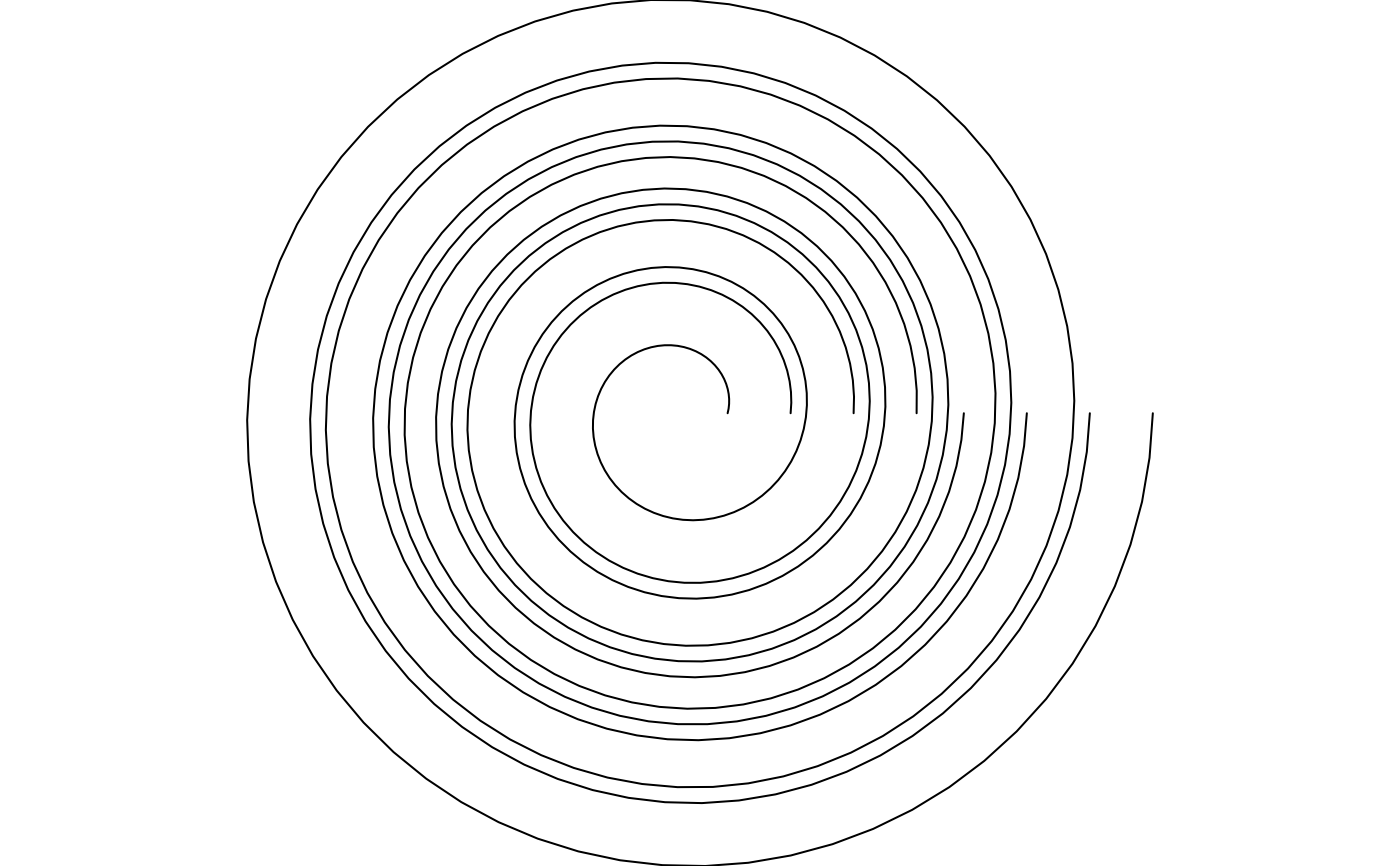
curve_spiral is a drawable whose path winds around a centroid
(x, y), sweeping through turns full revolutions while its radius
interpolates linearly from radius_start to radius_end. With
radius_start = radius_end this traces a circle repeated turns times
(visually indistinguishable from a single circle, since the path
retraces itself); the usual case has radius_start != radius_end, giving
an Archimedean-style spiral that grows or shrinks outward.
curve_spirals() is a vectorized version of curve_spiral(): each
argument may be a vector, recycled against the others via
purrr::pmap()'s own vctrs-based rules (any length-1 element is
broadcast to the common length; mismatched lengths greater than 1
raise an error). The result is a sketch containing one
curve_spiral() per recycled row, rather than a single drawable.
Usage
curve_spiral(
  x = 0,
  y = 0,
  radius_start = 0,
  radius_end = 1,
  turns = 3,
  n = 200L,
  trans = trans_identity(),
  ...
)

curve_spirals(
  x = 0,
  y = 0,
  radius_start = 0,
  radius_end = 1,
  turns = 3,
  n = 200L,
  trans = trans_identity(),
  ...
)
Arguments
- x, y
Centroid coordinates. Default
0.- radius_start, radius_end
Radius at the start/end of the path. Must be non-negative. Default
0/1.- turns
Number of full revolutions. Must be positive. Default
3.- n
Number of points used to approximate the spiral. Default
200L.- trans
A trans object applied to the curve's computed points. Default
trans_identity()(no transform).- ...
Arguments passed to
style().
Details
style@fill has no effect for curve_spiral() – see drawable's
geometry documentation for why "path" geometries have no interior to
fill. Passing fill via ... is still accepted (it's simply ignored at
draw time), since style() is shared across every geometry.
See also
Other 1D curves:
curve_arc(),
curve_bezier(),
curve_line(),
curve_raw(),
curve_scribble(),
curve_twist()
Examples
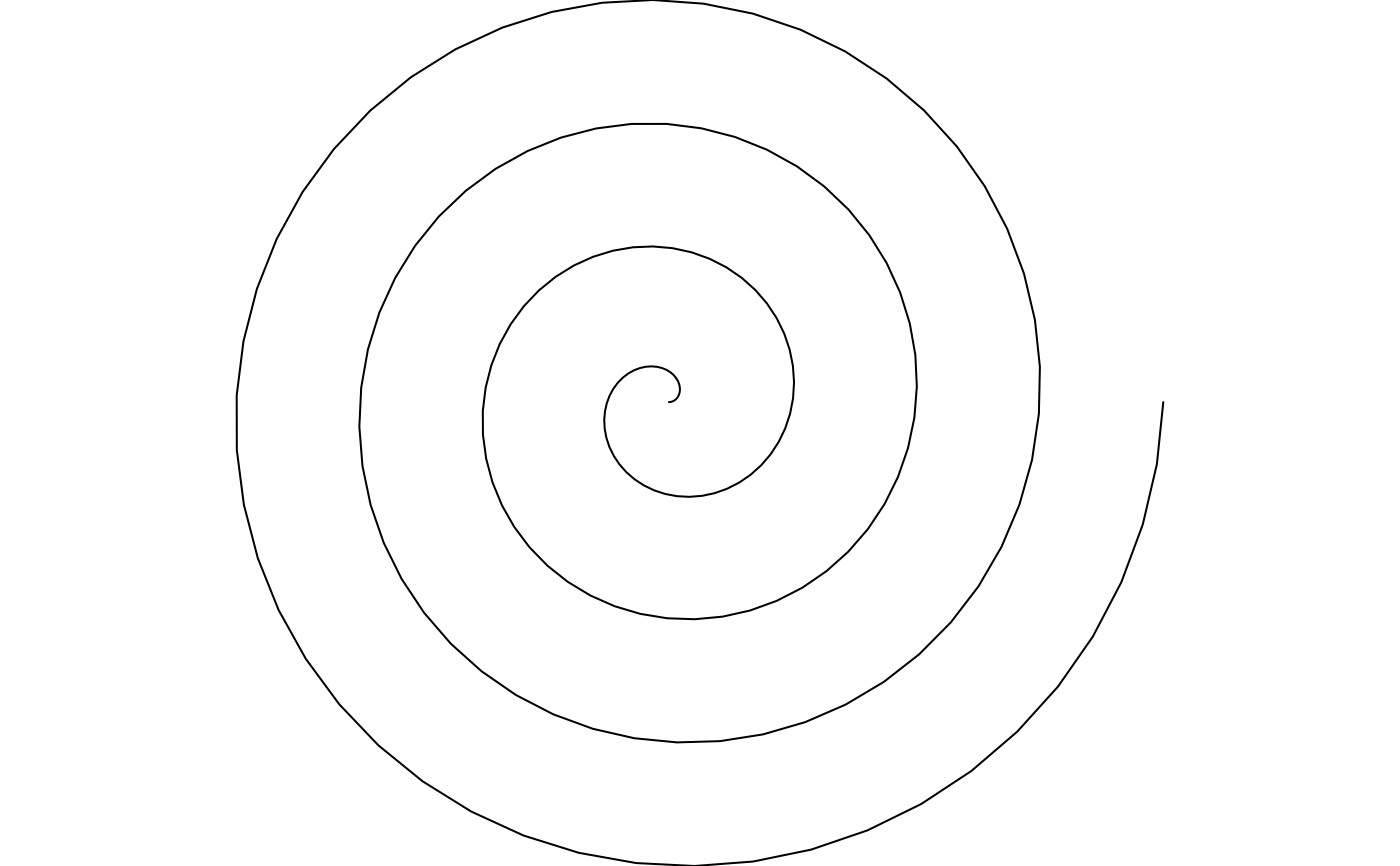
draw(curve_spiral(radius_start = 0, radius_end = 1, turns = 4))
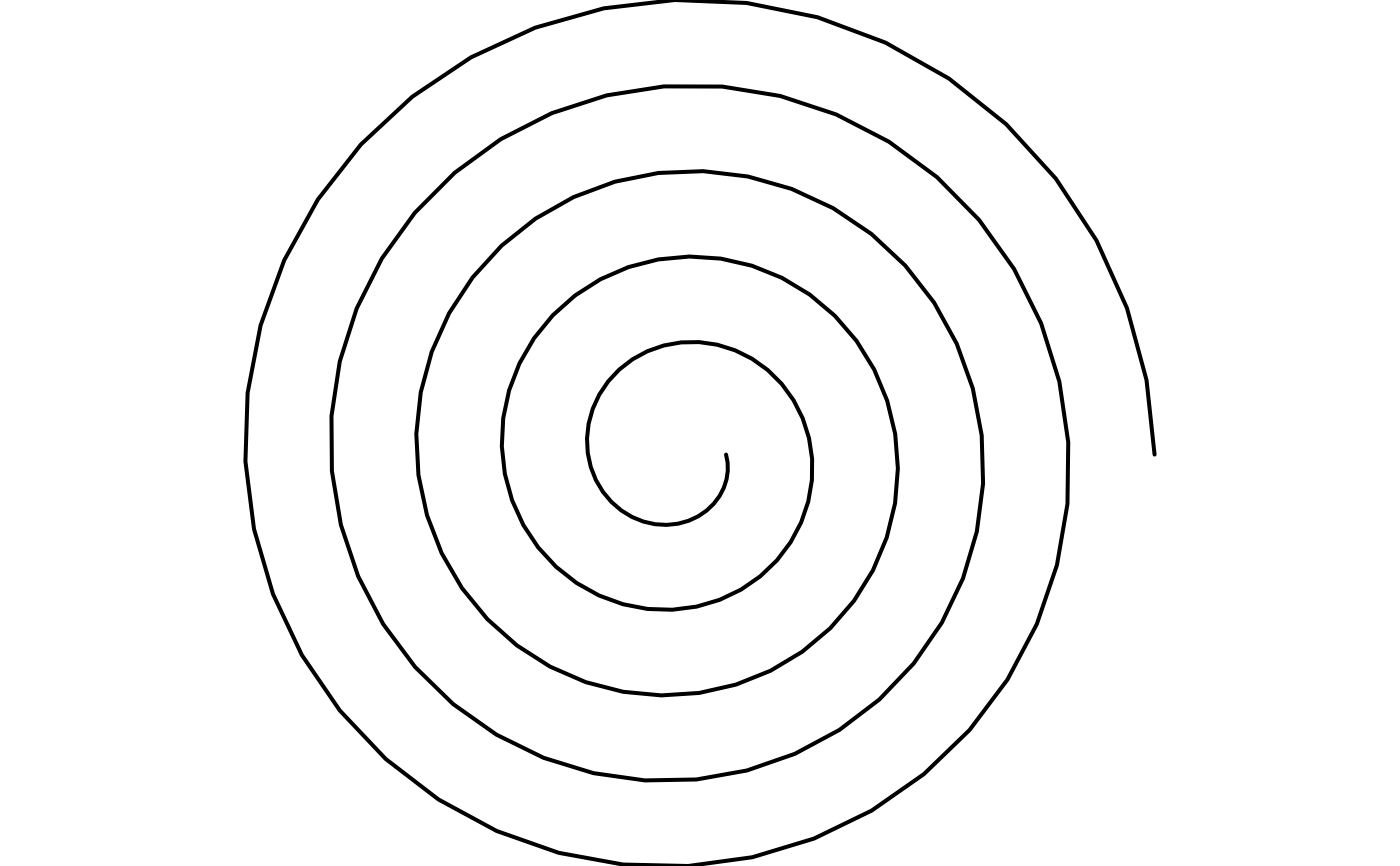
 # radius_start > radius_end spirals inward instead of outward
draw(curve_spiral(
radius_start = 1, radius_end = 0.1, turns = 5, linewidth = 2
))
# radius_start > radius_end spirals inward instead of outward
draw(curve_spiral(
radius_start = 1, radius_end = 0.1, turns = 5, linewidth = 2
))
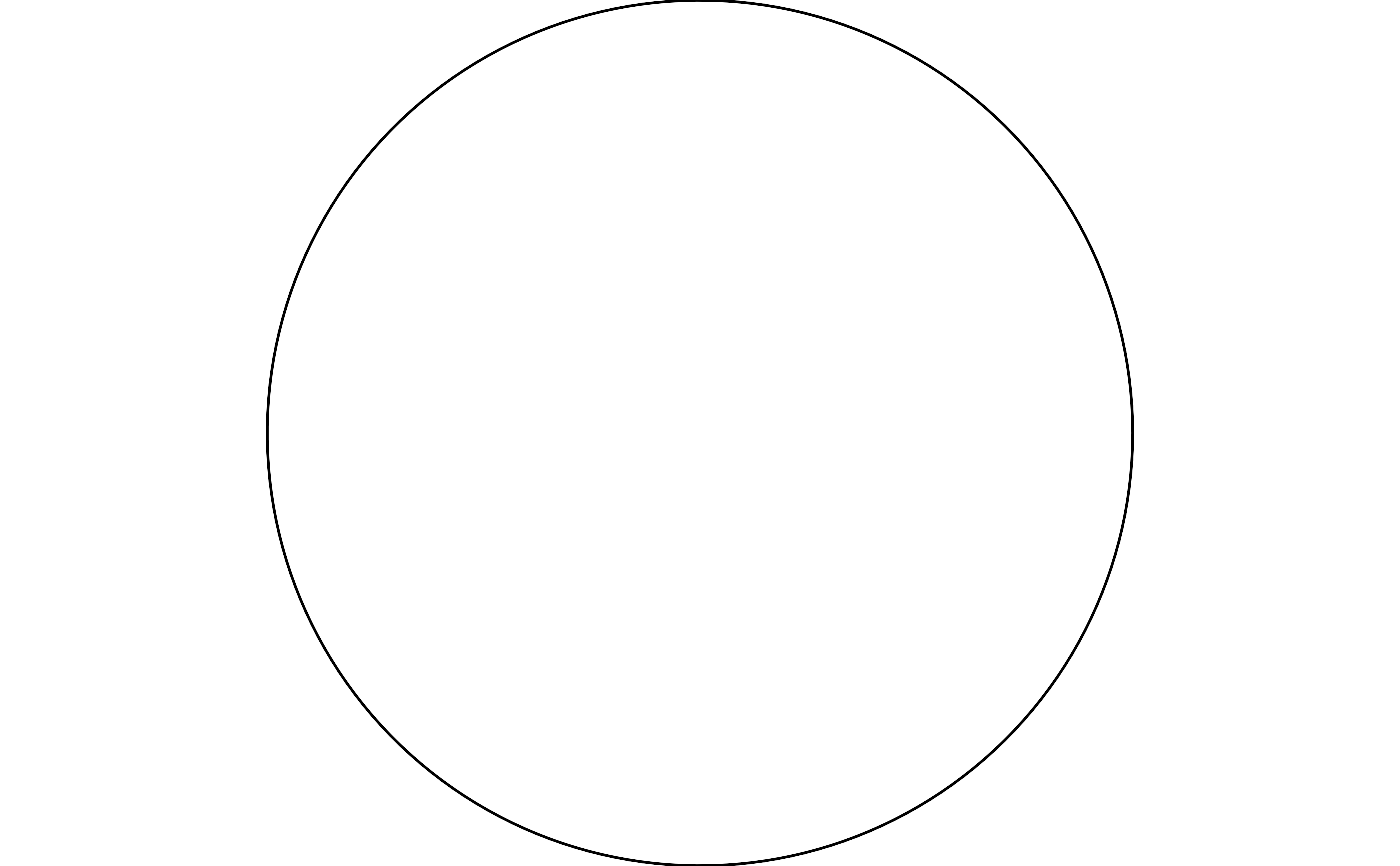
 # equal start/end radii retrace a circle -- rarely useful on its own,
# but shows turns has no effect on shape when radius doesn't change
draw(curve_spiral(radius_start = 1, radius_end = 1, turns = 3))
# equal start/end radii retrace a circle -- rarely useful on its own,
# but shows turns has no effect on shape when radius doesn't change
draw(curve_spiral(radius_start = 1, radius_end = 1, turns = 3))
 draw(curve_spirals(x = c(0, 3, 6), turns = c(2, 3, 4)))
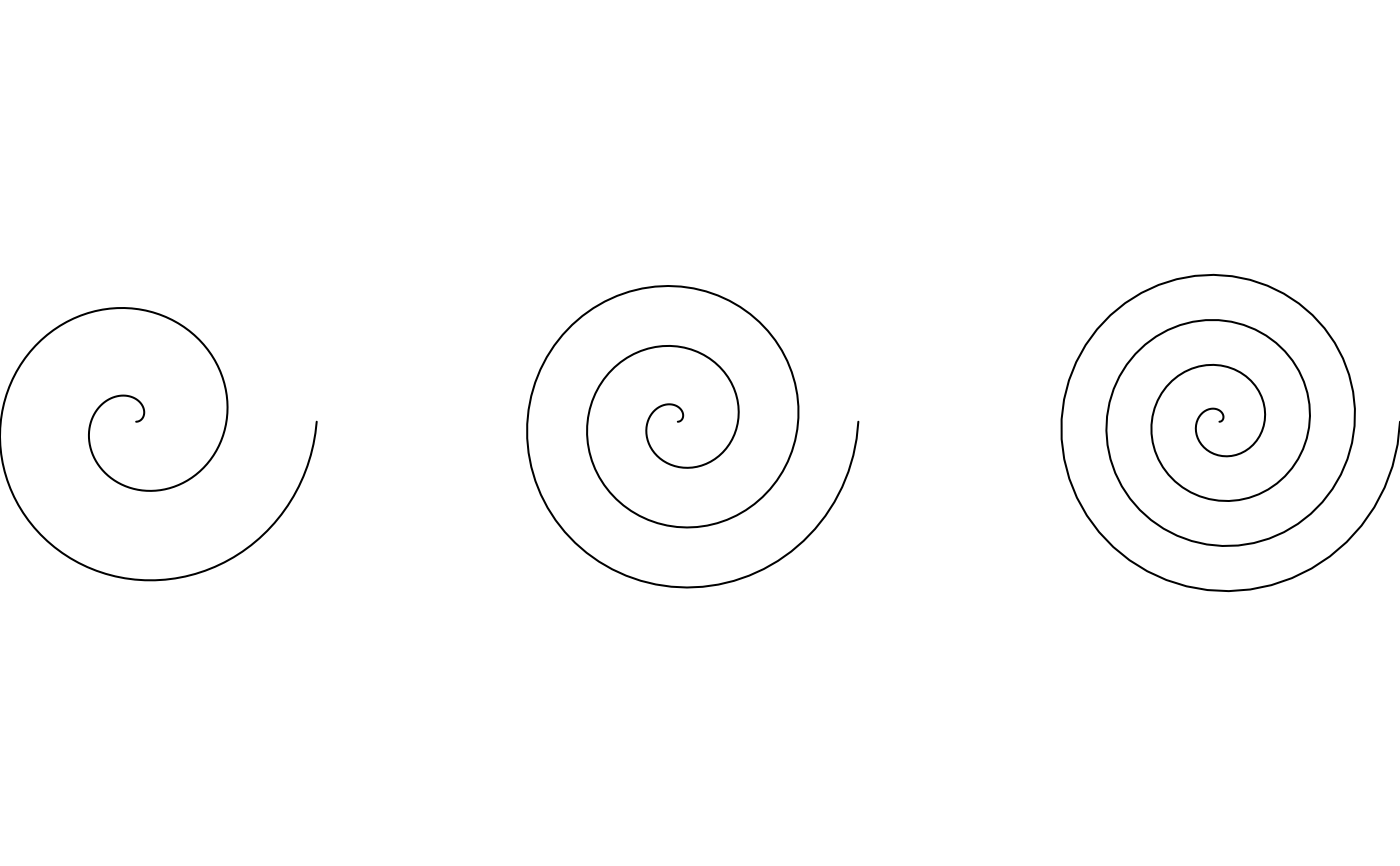 # nested spirals sharing a centroid, growing radius each time
draw(curve_spirals(
radius_start = seq(0.1, 0.5, length.out = 4),
radius_end = seq(0.6, 1, length.out = 4)
))
# nested spirals sharing a centroid, growing radius each time
draw(curve_spirals(
radius_start = seq(0.1, 0.5, length.out = 4),
radius_end = seq(0.6, 1, length.out = 4)
))