fill_marble() builds a grid::pattern() fill value resembling veined
marble: a set of stripes parallel bands running around the tile's u
axis, displaced by a fill_noise()-style torus-periodic turbulence
field (via the shared internal torus_grid()/torus_noise() helpers)
rather than left straight – the classic "sine of a coordinate plus
turbulence" recipe for procedural marble.
Usage
fill_marble(
  color = c("white", "black"),
  spacing = 0.5,
  aspect = NULL,
  resolution = 32L,
  stripes = 3L,
  warp = 4,
  frequency = 1,
  octaves = 3L,
  seed = 1L,
  extend = "repeat"
)
Arguments
- color
Two or more colours blended across each band, in order, via
grDevices::colorRamp(). Defaultc("white", "black").- spacing
Baseline tile size, as a fraction of the target's bounding box. Must be a positive number. Default
0.5.- aspect
Width-to-height ratio of the target polygon's bounding box. Must be a positive number, or
NULL(the default) to resolve it automatically from the real target's own bounding-box aspect ratio atdraw()time – see the fill class. Passing a fixed number instead computes the pattern once, immediately, against that value only.- resolution
Raster resolution (pixels per tile edge). Must be a positive integer of at least
2L. Default32L.- stripes
Number of bands running around the tile's
uaxis before turbulence displacement. Must be a positive integer. Default3L.- warp
Turbulence amplitude, in radians of displacement along the band coordinate. Must be a non-negative number. Default
4.- frequency
Noise frequency, as in
shape_blob(). Must be non-negative. Default1.- octaves
Number of turbulence octaves, as in
shape_blob(). Must be a positive integer. Default3L.- seed
Integer seed for the noise field, as in
shape_blob(). Default1L.- extend
Passed to
grid::pattern(). Default"repeat".
Value
A pattern object as returned by grid::pattern(), suitable for
use as the fill argument to grid::gpar().
Details
Periodicity needs two things, both already true here: the undisplaced
bands (sin(theta_u * stripes)) are periodic in u for any integer
stripes, since theta_u itself advances by exactly 2 * pi over one
tile width; and the turbulence added on top is periodic in both u and
v because it comes from torus_noise(), the same torus-sampling
technique fill_noise() uses for its own field. Adding one periodic
function to another (here, inside a further sin()) stays periodic, so
the combined result still tiles with no seam.
Unlike fill_noise() (opacity of one colour), the banding is rendered
as a blend across color via grDevices::colorRamp(), since a marble
texture's visual interest is the veining pattern itself rather than a
fade to transparency.
fill_noise()'s own faint tile-boundary rasterization seam (see its
details) can be more noticeable here: sin() turns a small mismatch in
the turbulence field into a visibly sharper edge in a band than the
same mismatch would produce in a plain opacity fade.
Examples
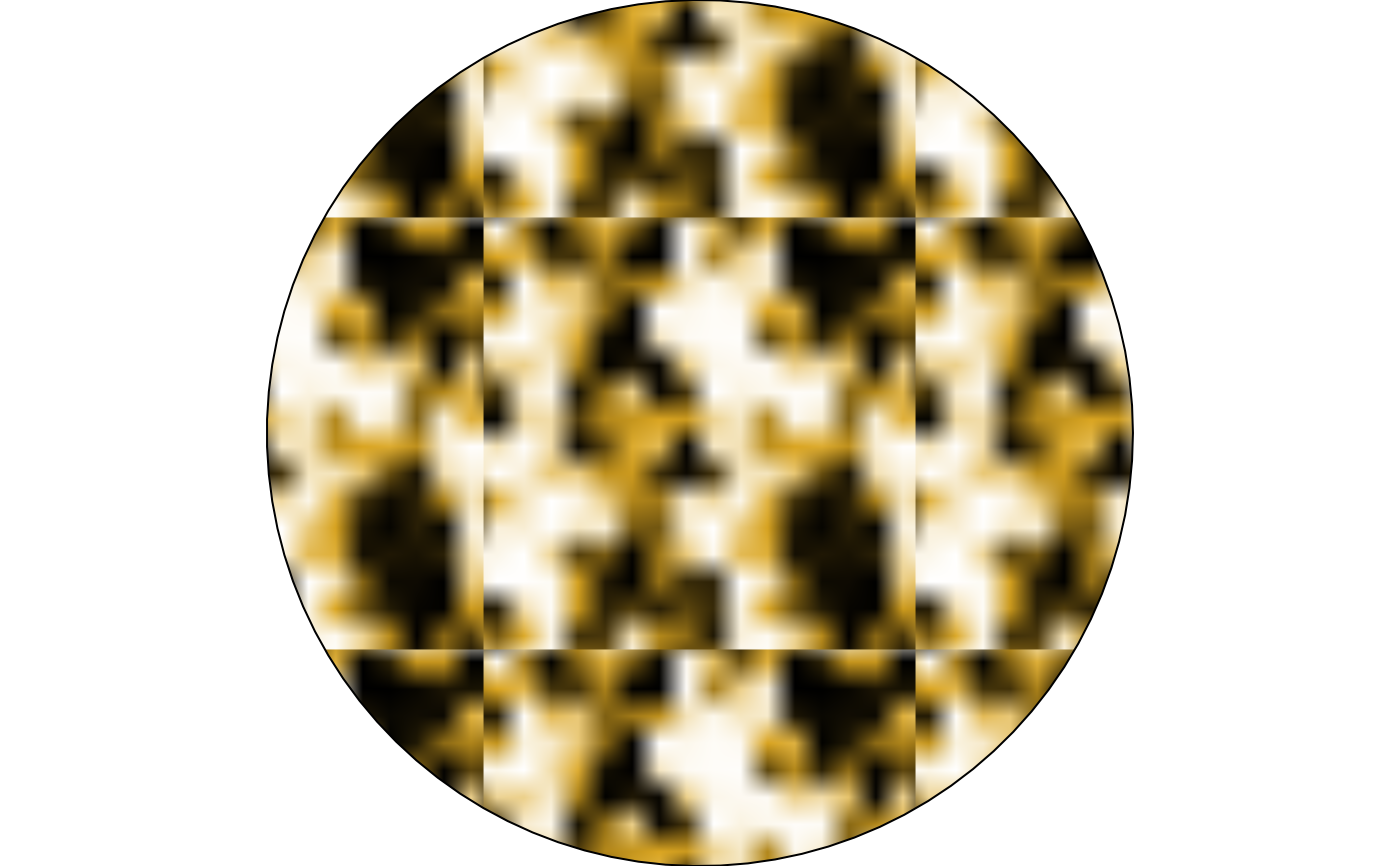
draw(shape_circle(fill = fill_marble(stripes = 4L, seed = 1274L)))
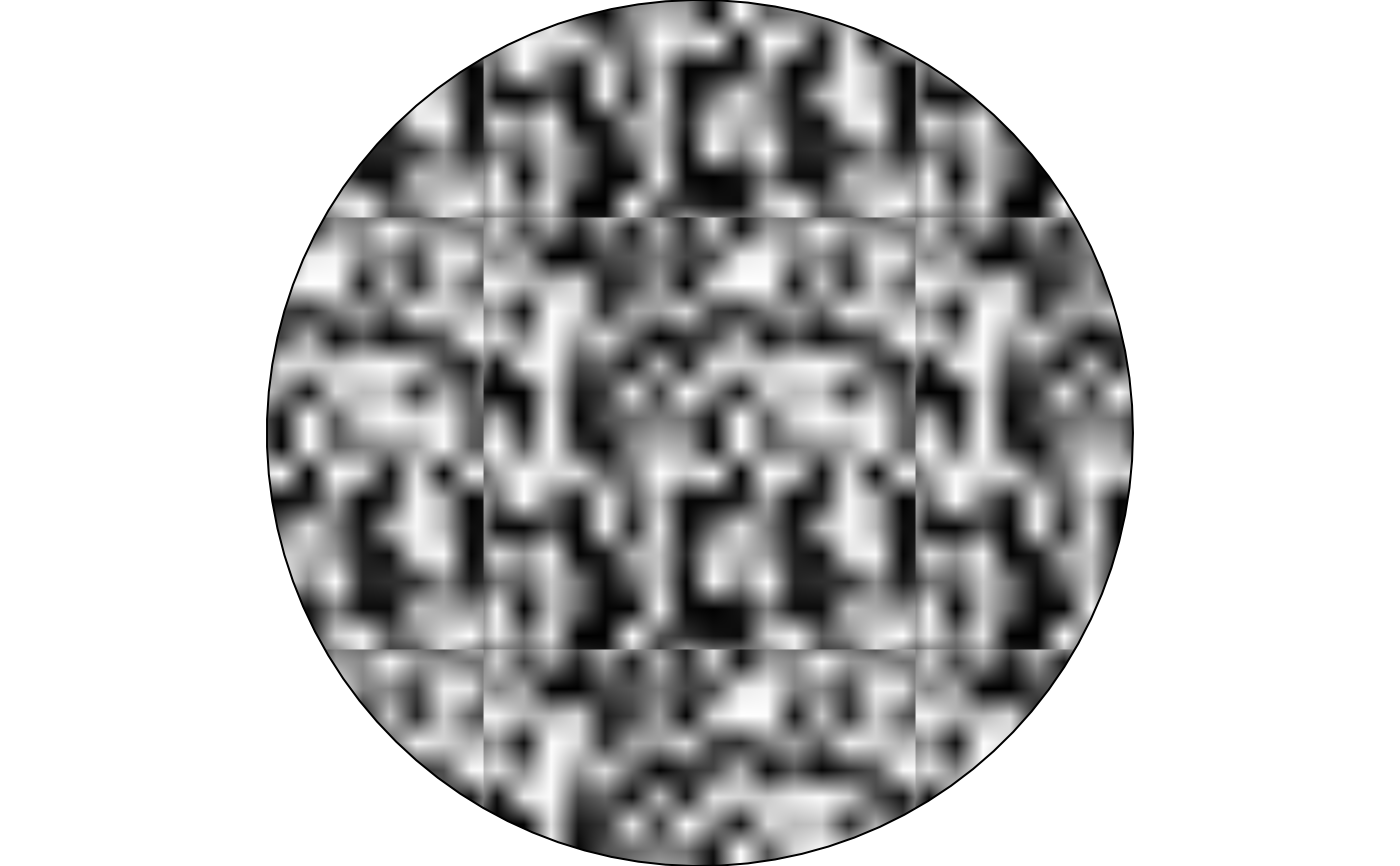
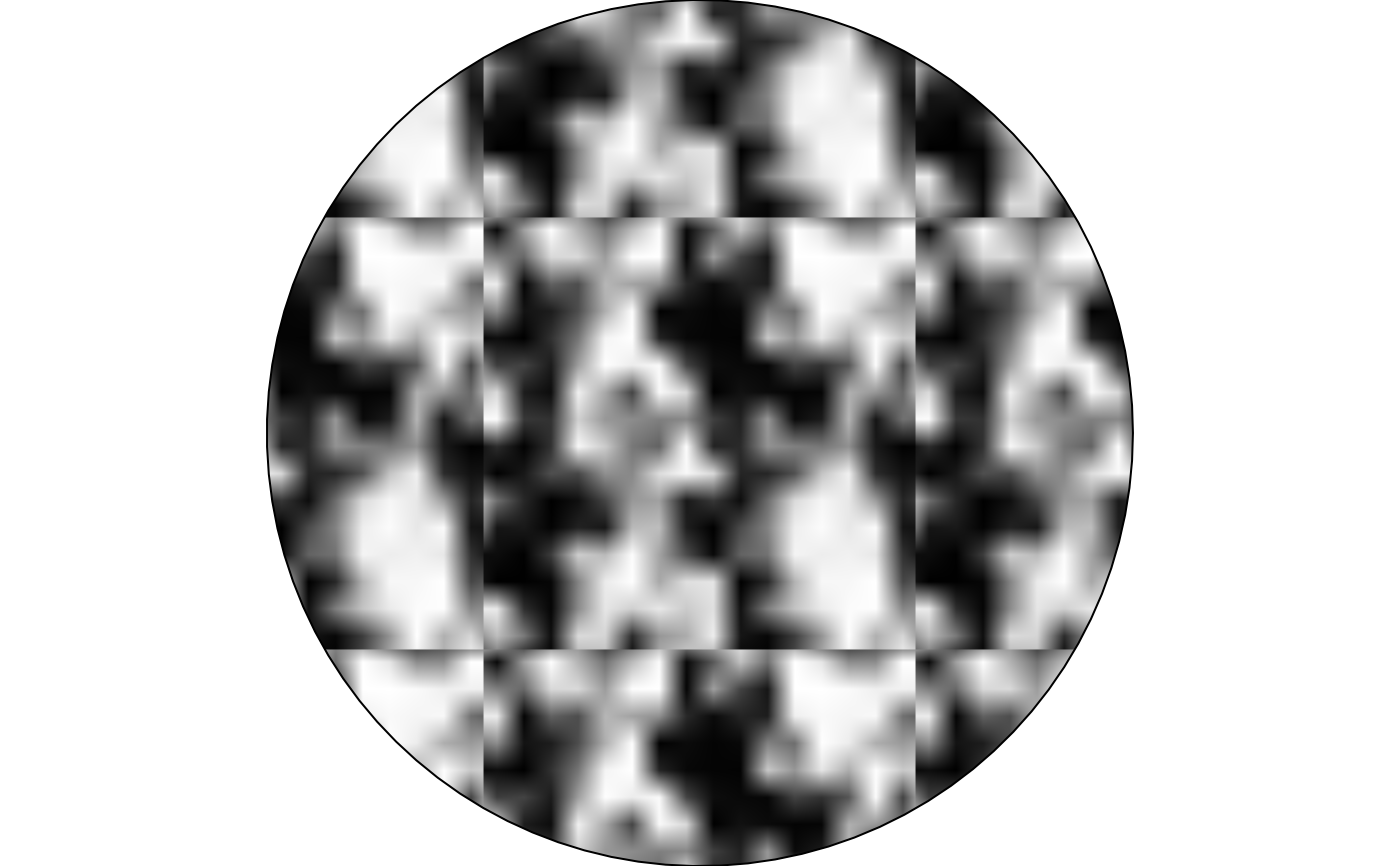 # more stripes and stronger warp give busier, more tangled veining
draw(shape_circle(fill = fill_marble(stripes = 8L, warp = 8, seed = 1274L)))
# more stripes and stronger warp give busier, more tangled veining
draw(shape_circle(fill = fill_marble(stripes = 8L, warp = 8, seed = 1274L)))
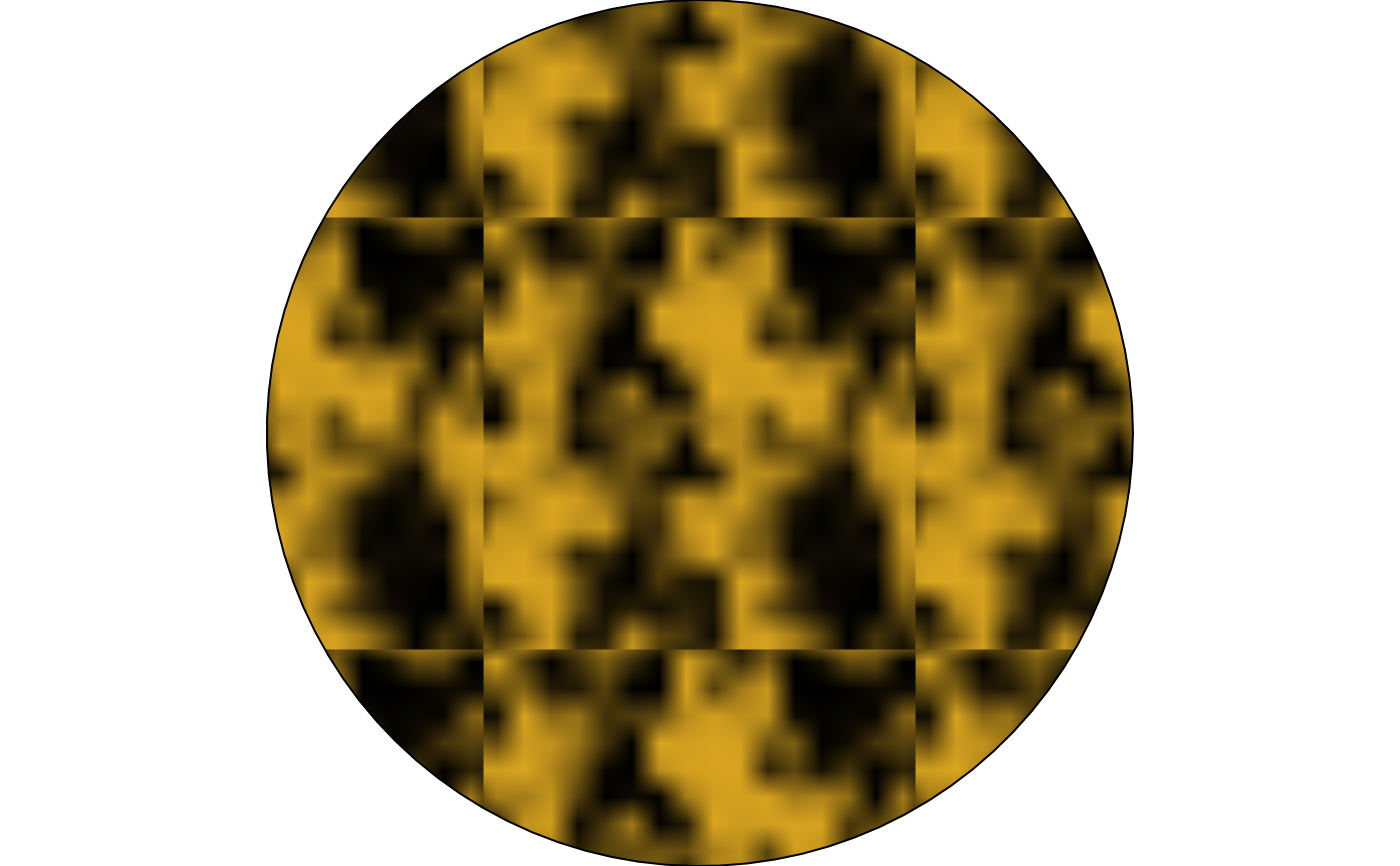
 # a different colour pair changes the veining's contrast entirely
draw(shape_circle(
fill = fill_marble(
color = c("black", "goldenrod"),
stripes = 4L,
seed = 1274L
)
))
# a different colour pair changes the veining's contrast entirely
draw(shape_circle(
fill = fill_marble(
color = c("black", "goldenrod"),
stripes = 4L,
seed = 1274L
)
))
 # three or more colours blend across the band in sequence
draw(shape_circle(
fill = fill_marble(
color = c("black", "goldenrod", "white"),
stripes = 4L,
seed = 1274L
)
))
# three or more colours blend across the band in sequence
draw(shape_circle(
fill = fill_marble(
color = c("black", "goldenrod", "white"),
stripes = 4L,
seed = 1274L
)
))